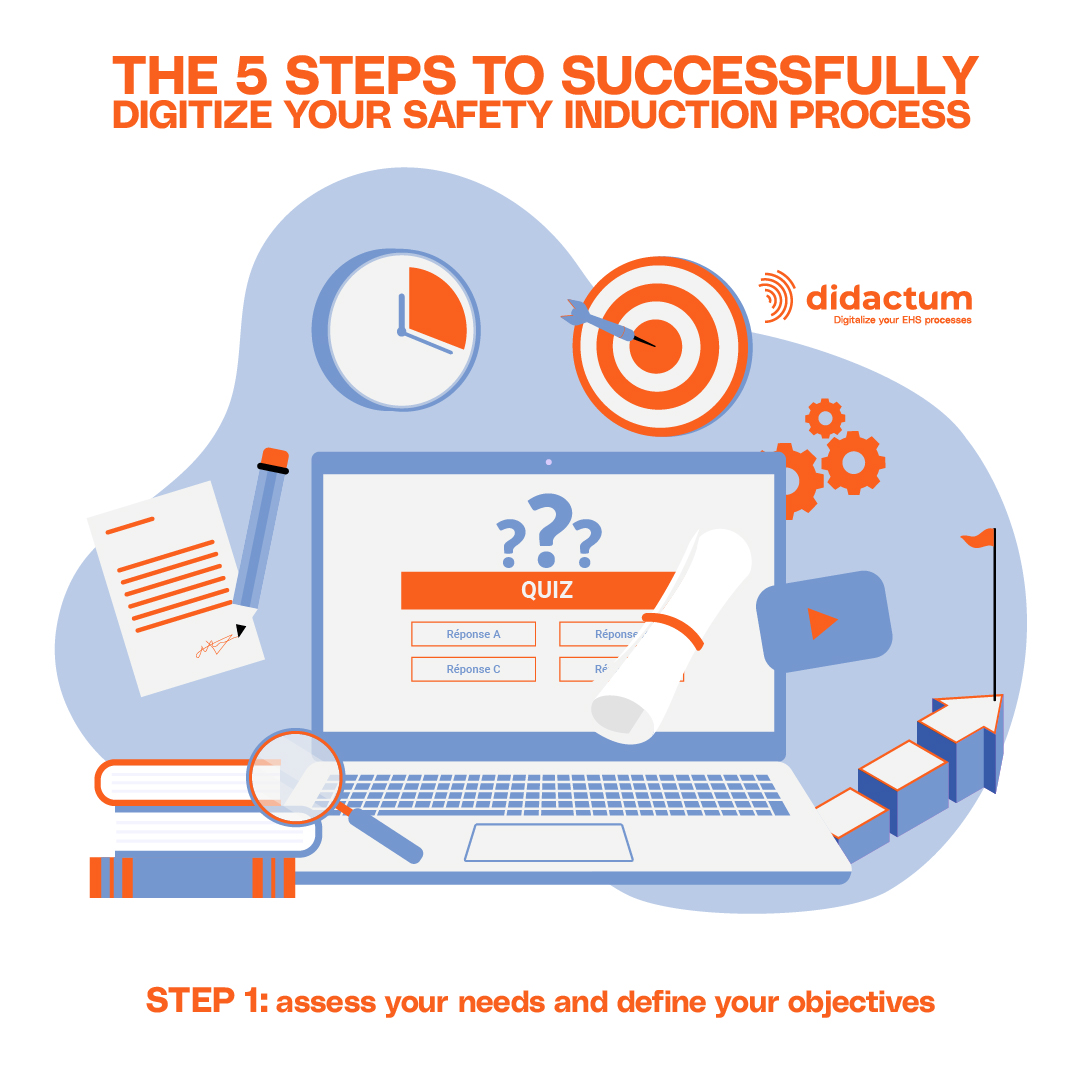
Succeeding at safety induction digitalization: Step 1

How to assess your needs and define your goals?

Digitalizing the Safety Induction process in an industrial company is a key driver for improving worker safety and simplifying the day-to-day management of safety procedures.

For 30 years, didactum has been supporting industrial companies in digitalizing their EHS training programs. We draw on this expertise to guide you through your Safety Induction digitalization project.

In this article, we explore the first fundamental step to successfully digitalizing your Safety Induction process: assessing your company’s specific needs and defining the goals you want to achieve.

Before implementing a digital solution for Safety Induction, it is essential to identify your company’s specific needs. This means reviewing existing onboarding processes, analyzing gaps and pain points, and clearly defining the goals you want to reach through digitalization.

Here are a few questions to ask yourself:

  1. Is the information provided during Safety Induction tailored to the different learner profiles and the specific hazards they are exposed to?
  2. Is there a way to verify that participants have properly understood the safety instructions?
  3. Does your EHS team spend too much time managing Safety Induction, at the expense of other equally important tasks?
  4. Is it easy to track each individual’s Safety Induction completion and digitally record validity dates?
  5. Is periodic refresher training managed efficiently?

Once you have identified the areas for improvement, here are the goals you can achieve through Safety Induction digitalization:

Free up time for your EHS teams

One of the primary goals of digitalizing Safety Induction is to free up valuable time for your EHS (Environment, Health & Safety) team. By automating repetitive administrative tasks — such as registering participants and delivering training content — EHS staff can focus on higher-value activities, such as risk analysis and implementing preventive measures.

Deliver tailored training content

Everyone working on your site — employees, temporary workers, contractors, visitors, and drivers — is exposed to hazards linked to their work environment and the nature of their assignment.

Digitalizing Safety Induction makes it possible to deliver personalized training content, adapted to each learner’s profile and the specific risks they face. By providing relevant, targeted information, employees and contractors are better prepared to handle potential hazards in their workplace.

Validate understanding of safety instructions

It is essential to ensure that every trained individual has fully understood the safety instructions.

To that end, a digital Safety Induction can include interactive quizzes to assess learner comprehension. These quizzes help verify that key information has been retained and that teams are ready to apply the recommended safety measures.

Track individual progress

Digitalization streamlines training follow-up and provides a detailed history for each participant.

It becomes possible to accurately track the training completed by each individual, along with their quiz and assessment results. This individualized tracking helps quickly identify additional training needs and ensures that every employee or contractor is fully prepared for the safety requirements of their role or assignment.

Record validity dates and manage refresher training

Finally, digitalizing Safety Induction makes it possible to digitally record training validity dates and efficiently manage periodic refresher cycles.

By maintaining an accurate record of the training completed by everyone working on or visiting the site — along with expiration dates — it becomes far easier to plan and implement the refresher training needed to keep safety competencies up to date.

In summary, the first step to successfully digitalizing your Safety Induction process is to carefully assess your company’s specific needs. By identifying existing gaps and clearly defining your goals, you lay the foundation for a successful transition to a fully digital Safety Induction process — delivering significant gains in operational efficiency and safety for everyone working on or visiting your site.

In upcoming articles, we will explore the next steps in this digitalization journey, with practical guidance for a successful rollout. Stay tuned!