
EHS Passport: how to centralize employee training, qualifications, and tracking information
Training records, qualifications, supporting documents, expiration dates… EHS information related to employees can quickly become scattered across multiple spreadsheets, folders, and documents.
The challenge is not simply storing this data, but being able to retrieve it quickly, verify that it is up to date, and make it accessible to the right people.
In this article, the term “EHS Passport” refers to an internal tool used to centralize and track this information. It is not the Passeport de prévention established by the French Ministry of Labor, which is a separate national system.
Identify the information currently scattered across different sources
Before looking for a tool, it is important to understand how information is actually managed today.
Where are training records stored? Where are supporting documents kept? Who tracks expiration dates? Do EHS and HR teams use the same sources? How long does it take to retrieve an employee’s document?
These questions help identify which information would benefit from being consolidated and which tasks could be simplified.
Having multiple storage locations is not necessarily the problem. Difficulties arise when cross-referencing them becomes time-consuming or when important information is hard to find.
Centralize the information needed for EHS tracking
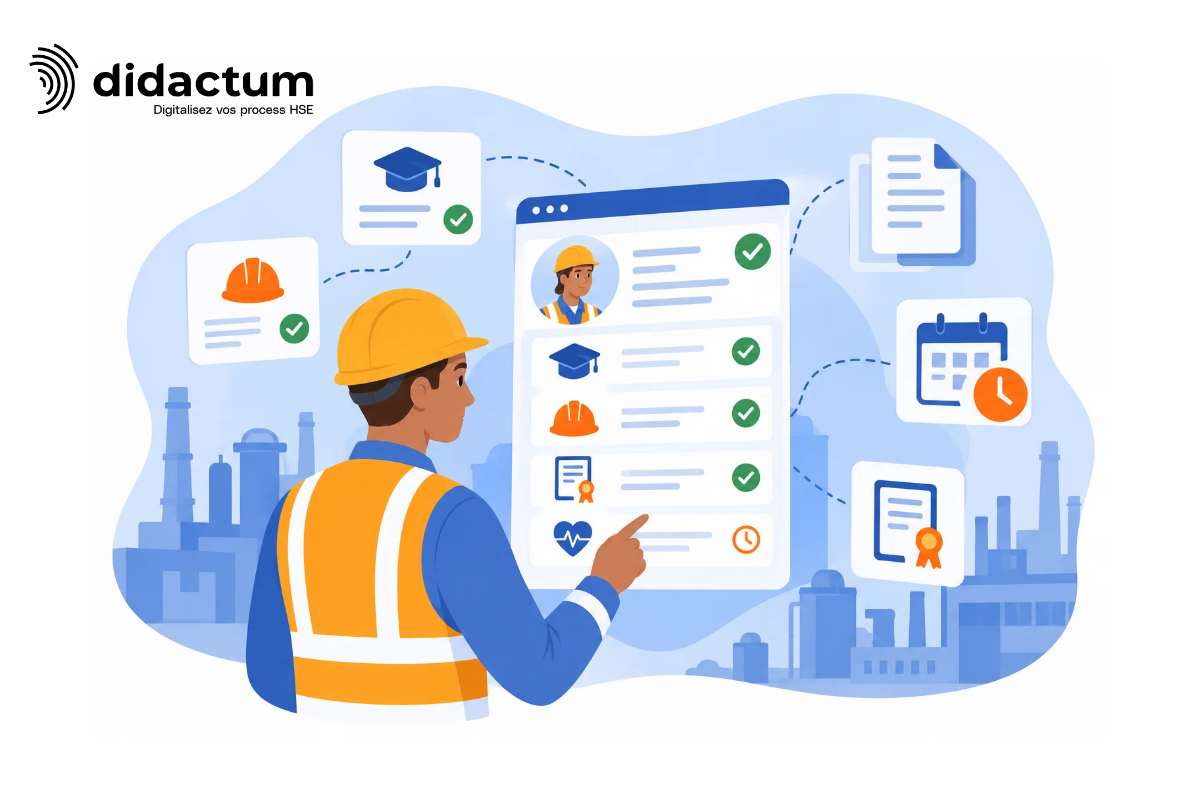
Once the requirements have been identified, the goal is to bring together the information that is genuinely useful for employee tracking: completed training, qualifications and authorizations, expiration dates, and supporting documents.
The benefit is being able to access the relevant data and, when necessary, the document that supports it, all from a single location.
This approach can replace searches across multiple spreadsheets and folders with a single point of access.
This is one of the objectives of the EHS Passport developed as part of Nexans Calais’ digitalization project: bringing together training records, qualifications and authorizations, and related documents to make information easier to access.
Make information accessible when it is needed
Centralizing data is not enough. It must also be accessible in the situations where it is needed: in the field, during an audit, or when an employee works at another site.
Access should therefore be designed around actual usage.
Several options are possible: smartphone access, an employee portal, a QR code, or access through an employee badge. The goal remains the same: avoiding the need to exchange emails or search through multiple folders to retrieve information.
In the Nexans project, the EHS Passport is intended to be accessible through a QR code linked to the employee’s badge. This will allow employees to retrieve their information and supporting documents, including when working at another site.
Define who can access which information
Centralizing data does not mean that everyone should be able to view all the information.
Employees may need access to their training records and supporting documents. The EHS department may require more comprehensive information for tracking purposes. Other authorized individuals may only need to verify whether a training course or qualification remains valid.
It is therefore useful to define access permissions before digitalizing the process:
- Which information can employees access?
- Which information is restricted to EHS teams?
- Which data can be viewed during an inspection?
- Which documents must remain confidential?
For example, the Nexans project provides for authorized individuals to view the expiration date of an employee’s occupational health monitoring status, while the corresponding certificate remains accessible to the employee concerned and the EHS department.
This approach helps make information accessible to users while respecting the different levels of access required.
Move from storing information to anticipating expiration dates
A spreadsheet can show expiration dates. But someone still needs to check it regularly.
As the number of employees and training records increases, manually tracking expiration dates can become a significant administrative task. The challenge is to move from periodic checks to proactive management.
A digital EHS Passport can link recorded information to alerts. When a training course is approaching its expiration date, for example, a notification can be triggered to help anticipate renewal.
This is the approach planned for the Nexans project: both the employee and the EHS team are to receive alerts when a training course is nearing its expiration date.
The intended benefit is straightforward: instead of manually identifying every upcoming deadline, teams receive information that prompts them to take action.
Integrate the EHS Passport into a broader approach
An EHS Passport can address a specific need, but it can also become part of a broader digitalization initiative.
The challenge is to avoid adding another tool every time a new process is introduced. If Safety Induction, employee tracking, and safety protocols are progressively digitalized, integrating them into the same environment can simplify management and everyday use.
This is the approach taken by Nexans: following Safety Induction, the EHS Passport represents a new step before other processes, including safety protocols, are considered.
This phased approach makes it possible to start with actual needs rather than attempting to transform everything at once.
Centralize information to simplify EHS tracking
An EHS Passport is therefore about more than replacing a paper document with a digital version.
To be genuinely useful, it must answer several practical questions: Where can information be found? Who can access it? How can it be retrieved when needed? And how can upcoming deadlines that require action be anticipated?
This approach aligns with the broader digitalization of EHS processes. With didactum, teams can centralize different processes within a single platform while digitalizing them progressively according to their priorities: Safety Induction, prevention plans, safety protocols, training tracking, and qualifications and authorizations.
The EHS Passport can thus become another component of a digital EHS environment, with one shared objective: making day-to-day work easier for teams while improving information tracking and traceability.
Ready to start digitalizing your EHS processes?
For 30 years, didactum has been helping EHS teams through this transformation with a SaaS platform designed around the realities of industrial operations. If you want to simplify the management of your prevention plans while strengthening compliance, contact our team to discuss your needs.
We put this expertise to work to guide you through your digitalization project and help you digitalize your EHS processes.
Our experts are, of course, available to support you throughout this transformation.
Contact us today for a personalized consultation and discover how our solutions can precisely meet your needs.
FAQ
Digitalizing your EHS processes helps strengthen regulatory compliance, improve data traceability, and simplify document management. Didactum enables industrial sites to replace paper and Excel-based systems with more reliable digital workflows.
The most relevant processes include safety induction, prevention plans, driver safety protocols, permit-to-work, and safety training tracking. Didactum structures these processes within a SaaS platform designed for real-world industrial operations.
Digitalized EHS processes help reduce errors, duplicate entries, document loss, and manual follow-ups. With didactum, EHS teams gain better visibility, faster response times, and improved operational performance.
A strong EHS platform should centralize information, track approvals, simplify workflows, and provide clear visibility into ongoing processes. Didactum addresses these needs with a SaaS solution designed for industrial sites and real-world operational constraints.
 Contact us