
Why the field remains the final judge in an EHS digitalization project
In many EHS digitalization projects, the initial discussions begin around a table.
Processes are mapped, workflows are defined, responsibilities are assigned, and performance indicators are identified. On paper, everything seems coherent.
Yet once deployed, some solutions produce results that are very different from what was expected.
Features that are barely used. Steps that are bypassed. Procedures that seemed relevant but ultimately slow teams down
This is a common occurrence.
Not because projects are poorly designed, but because one reality remains: when it comes to EHS, it is always the field that validates or challenges the choices that have been made.
And very often, the most valuable improvements come precisely from those who deal with operational constraints on a daily basis.
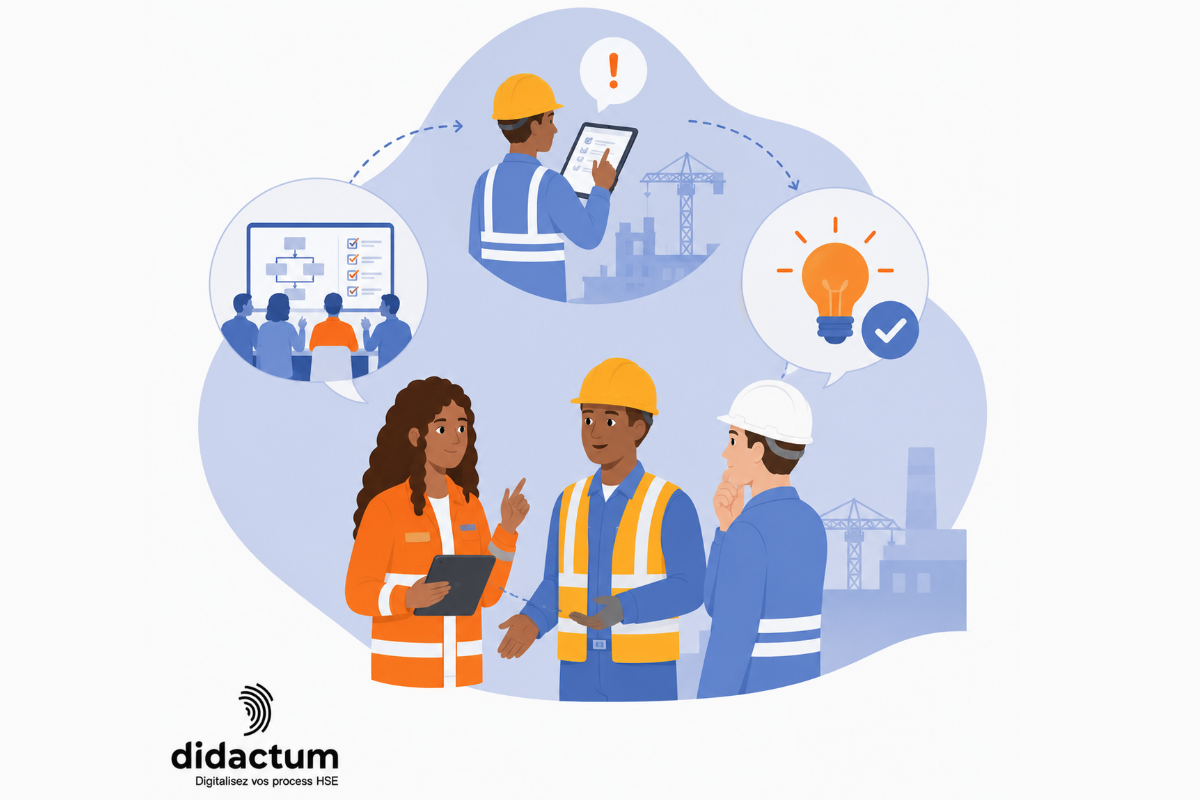
Friction points rarely emerge during project planning meetings
When a process is studied from a distance, it generally appears smoother than it actually is.
On the ground, situations are often more complex.
A driver arrives ahead of schedule. A contractor is replaced at the last minute. A manager has to deal with several urgent issues at the same time. A temporary worker arrives without having completed the full onboarding process.
These situations are not always reflected in procedures.
Yet they play an important role in the day-to-day work of site teams.
It is precisely these friction points that reveal the limitations of a process and highlight the most relevant opportunities for improvement.
The best ideas often come from users
In many organizations, the most effective improvements do not necessarily come from headquarters. They emerge directly from the field. An EHS manager may, for example, find a way to reduce the time spent on Safety Induction, while a site adapts its organization to make contractor onboarding smoother, or a team simplifies the process for drivers to avoid recurring misunderstandings.
Initially, these initiatives often address a local problem and constraints specific to a particular site. But when they deliver a visible improvement, they can gradually become a source of inspiration for the organization as a whole. This is how many best practices spread across industrial organizations: they start with a concrete solution developed in the field, before being adapted and rolled out on a broader scale.
The field reveals what really creates value
In many organizations, the most effective improvements do not necessarily come from headquarters. They emerge directly from the field. An EHS manager may, for example, find a way to reduce the time spent on Safety Induction, while a site adapts its organization to make contractor onboarding smoother, or a team simplifies the process for drivers to avoid recurring misunderstandings.
Initially, these initiatives often address a local problem and constraints specific to a particular site. But when they deliver a visible improvement, they can gradually become a source of inspiration for the organization as a whole. This is how many best practices spread across industrial organizations: they start with a concrete solution developed in the field, before being adapted and rolled out on a broader scale.
A solution that works today may not be the right fit tomorrow
Another reality that is often underestimated is that industrial environments are constantly evolving. Activities change, contractors change, the number of workers increases, regulatory requirements become more demanding, and organizations undergo restructuring.
A solution that is perfectly suited to a particular point in time may therefore require adjustments a few months or years later. This is why the most sustainable projects are rarely those that seek to permanently lock processes in place. Instead, they maintain the ability to listen and adapt.
The field then becomes an ongoing source of improvement rather than simply a validation stage.
Structure without losing touch with actual use
Recognizing the importance of the field does not mean abandoning any form of structure. EHS projects need clear governance, common rules, and shared objectives, but this structure must remain connected to actual use.
Organizations that successfully implement digitalization projects are often those that manage to combine these two dimensions: a framework that is clear enough to ensure consistency across the project, while still leaving enough room to listen to the field and adapt practices when necessary. One cannot work sustainably without the other.
The field is not a step, it is a compass
In EHS projects, the field is often considered simply a testing phase before a broader rollout. The reality is often different: it does not just serve to validate a solution. Above all, it reveals real problems, measures the usefulness of the actions undertaken, and identifies the improvements that will have the greatest impact for users.
This is why the most robust approaches are not necessarily those that were designed entirely upfront. They are often the ones that are willing to confront actual usage early on, listen to feedback from teams, and progressively adapt practices based on the needs observed.
Because in an EHS digitalization project, the real judge is neither the software, nor the process, nor even the steering committee: it is always the field.
Turning field feedback into a success factor
In EHS digitalization projects, difficulties rarely arise where they are expected. What appears to work on paper may prove poorly suited to the day-to-day constraints faced by EHS managers, supervisors, contractors, or field operators.
This is why the most effective approaches involve future users in the process from an early stage. Understanding their constraints, observing their practices, and gathering their feedback often makes it possible to identify roadblocks that would remain invisible during a design process alone.
At didactum, this listening phase plays an important role in deployment projects. Our teams work with EHS managers as well as the users concerned to build workflows that genuinely reflect how work is carried out in the field. This approach helps support solution adoption, limit workarounds, and enable a smoother rollout across sites.
Ready to start digitalizing your EHS processes?
For 30 years, didactum has been helping EHS teams through this transformation with a SaaS platform designed around the realities of industrial operations. If you want to simplify the management of your prevention plans while strengthening compliance, contact our team to discuss your needs.
We put this expertise to work to guide you through your digitalization project and help you digitalize your EHS processes.
Our experts are, of course, available to support you throughout this transformation.
Contact us today for a personalized consultation and discover how our solutions can precisely meet your needs.
FAQ
Digitalizing your EHS processes helps strengthen regulatory compliance, improve data traceability, and simplify document management. Didactum enables industrial sites to replace paper and Excel-based systems with more reliable digital workflows.
The most relevant processes include safety induction, prevention plans, driver safety protocols, permit-to-work, and safety training tracking. Didactum structures these processes within a SaaS platform designed for real-world industrial operations.
Digitalized EHS processes help reduce errors, duplicate entries, document loss, and manual follow-ups. With didactum, EHS teams gain better visibility, faster response times, and improved operational performance.
A strong EHS platform should centralize information, track approvals, simplify workflows, and provide clear visibility into ongoing processes. Didactum addresses these needs with a SaaS solution designed for industrial sites and real-world operational constraints.
 Contact us