
Safety Induction: 5 questions to ask before digitalizing your process
Safety Induction is an essential step when a new employee, intern, visitor, or contractor arrives at an industrial site. But as the number of arrivals increases, more user groups need to be accommodated, or EHS teams have to manage several inductions in a single day, the process can quickly become time-consuming.
The temptation is then to look for a digital solution to replace paper documents, PowerPoint presentations, or quizzes. Yet before choosing a tool, one question is worth asking: is the problem really the format, or does it lie in the way the process itself works?
Digitalizing Safety Induction is not simply about moving from a paper document to a screen. It is an opportunity to review the different steps in the process, how they are organized, and the role of the EHS team throughout.
Here are five questions to ask before getting started.
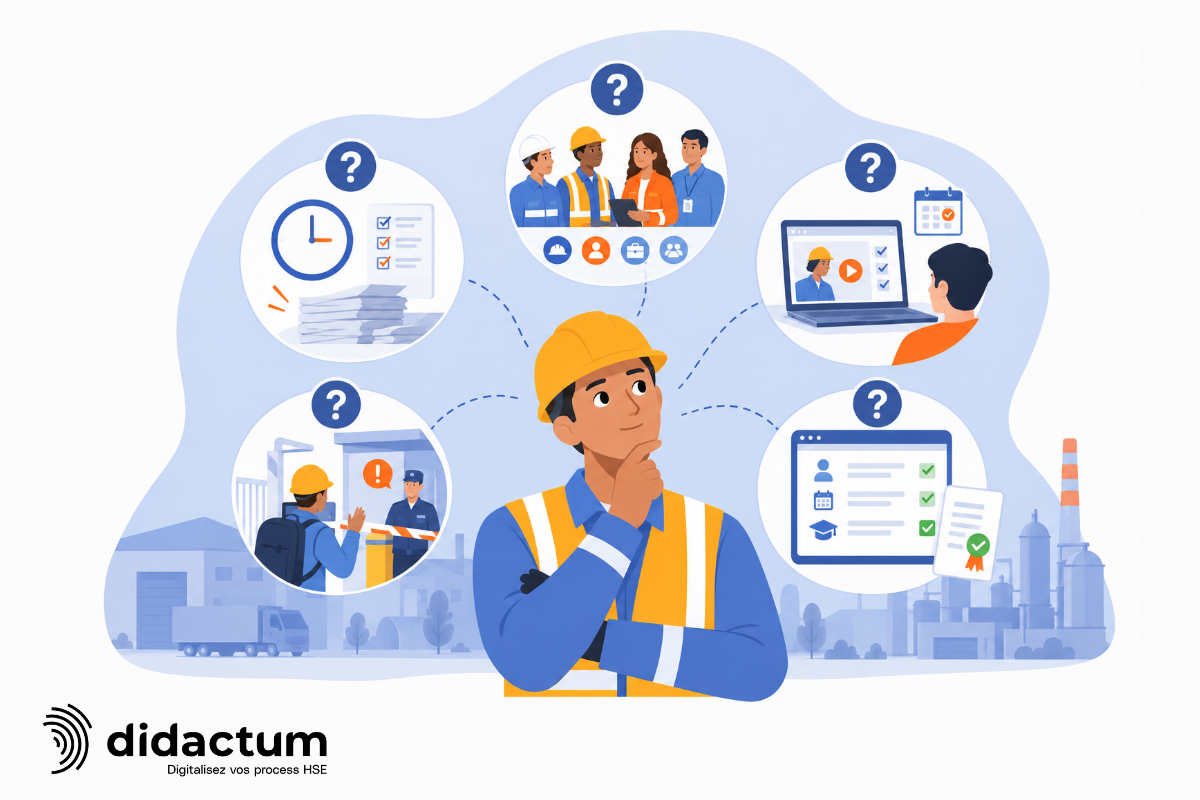
1. How much time does the process actually take from EHS teams?
The first step is to take a close look at what happens between a person’s arrival on site and the completion of their Safety Induction.
Depending on the organization, the process may include a presentation of safety rules, a quiz, grading the results, issuing a completion certificate, and archiving the documents. Additional tasks may include communicating with contractors, checking which inductions have been completed, or retrieving information when proof of completion is requested.
Individually, each of these tasks may seem relatively simple. But when repeated, they can represent a significant workload for an EHS team.
It is therefore useful to distinguish between two types of tasks:
- those that genuinely require EHS expertise and involvement;
- those that are primarily repetitive or administrative.
This distinction already helps identify an initial opportunity for improvement. The goal is not necessarily to reduce EHS involvement, but to allow EHS teams to spend more time on activities where their presence adds the most value: supporting teams, preventing incidents, analyzing risk situations, and being present in the field.
2. Which steps can be completed before arrival on site?
The second question concerns when Safety Induction takes place.
Does it necessarily have to be completed when someone arrives on site? Could some steps be completed a few hours or even a few days beforehand?
For many user groups, part of the process can potentially be completed in advance: reviewing safety instructions, learning about the main hazards, completing a knowledge assessment, or providing certain information.
This approach is particularly useful for contractors and visitors whose activities are scheduled in advance. Safety Induction can then become a preparatory step before work begins, rather than a formality to complete when someone arrives at the security gate.
This does not mean that all human involvement can be eliminated. Some situations still require a reminder, a verification, or on-site assistance. The challenge is to determine what needs to happen before arrival and what genuinely needs to happen upon arrival.
This approach is particularly useful for contractors and visitors whose activities are scheduled in advance. Safety Induction can then become a preparatory step before work begins, rather than a formality to complete when someone arrives at the security gate.
Cela ne signifie pas pour autant que toute intervention humaine disparaît. Certaines situations nécessitent toujours un rappel, une vérification ou une intervention sur site. L’enjeu consiste plutôt à déterminer ce qui doit être fait avant l’arrivée et ce qui doit réellement être fait à l’arrivée.
This review also helps clarify how responsibilities should be shared between the EHS team, the contracting party, the security desk, and the person completing the induction.
3. How should different user groups be accommodated?
An industrial site may welcome very different people: new employees, interns, temporary workers, visitors, contractors, and other workers carrying out occasional activities.
Everyone needs to understand the site’s essential safety rules, but their needs are not necessarily the same.
A visitor staying for a few hours does not need the same level of information as an employee who works in the facility every day. Similarly, a contractor working in a specific area may need additional instructions related to their activities.
This does not necessarily mean creating a completely different learning path for every user group. A more effective approach may be to define:
- a common set of essential safety instructions;
- additional information based on the user’s profile;
- specific content related to certain work activities.
The goal is to find the right balance between consistent messaging and relevant information.
This is also important when maintaining the system: the more numerous and complex the learning paths become, the harder they can be to update.
4. How does the process work outside the ideal scenario?
A process may seem perfectly efficient when tested under normal conditions. But its true effectiveness often becomes apparent when unexpected situations arise.
What happens when a visitor arrives without completing their Safety Induction? When work is scheduled at the last minute? When the link to access the learning path has not been sent? Or when someone simply cannot complete their induction before arriving on site?
These situations need to be anticipated when designing the process.
A digitalized system should therefore account for more than just the standard workflow. It must also define how to handle exceptions without having to recreate the original manual process every time.
For example, a solution could provide on-site access to the learning path for people who were unable to complete it in advance.
This consideration is particularly important in industrial environments where the flow of visitors, contractors, and other workers can be difficult to predict.
5. What level of traceability is needed at the end of the process?
The final question is just as important: once Safety Induction has been completed, what information needs to be available?
The answer depends on each organization’s needs, but it may be necessary to know:
- who completed the Safety Induction;
- when it was completed;
- which learning path was followed;
- whether the knowledge assessment was passed;
- which completion certificate was issued.
When a process relies on paper questionnaires, Excel files, or archived documents, retrieving information several weeks or months later can require additional work.
Digitalization can help centralize this data and make it easier to access and use. But once again, the question should be asked before choosing a solution: which information is genuinely useful for day-to-day operations, inspections, or audits?
Traceability should not be treated as a secondary benefit of digitalization. It is an integral part of the process that needs to be designed.
How can you successfully digitalize your Safety Induction process?
The five questions above are primarily intended to help prepare for process digitalization. They do not call the value of digital tools into question. On the contrary, they help define what the solution needs to handle and how it should fit into the existing organization.
Effective digitalization therefore relies on several principles: identifying tasks that can be automated, enabling people to complete the learning path in advance whenever possible, adapting content to different user groups, and ensuring that records remain easily accessible.
The goal is not to digitalize every step indiscriminately, but to build a process that reduces administrative tasks while keeping the EHS team in control of the overall process.
This approach also makes it possible to evolve the organization gradually: start with Safety Induction, identify the benefits achieved, and then extend digitalization to other EHS processes as new needs arise.
Digitalizing Safety Induction means rethinking the process
Digitalizing Safety Induction is not simply about replacing a paper document or PowerPoint presentation with an online learning path. It is an opportunity to rethink the entire process: which steps can be completed in advance, which tasks can be automated, which activities must remain under EHS team oversight, and which information needs to be tracked.
C’est précisément dans cette logique que s’inscrit didactum : digitaliser les processus HSE en tenant compte de leur fonctionnement réel sur le terrain. L’Accueil Sécurité peut ainsi constituer une première étape, avant d’étendre progressivement la digitalisation à d’autres processus QHSE du site, au sein d’une même plateforme.
L’objectif n’est donc pas simplement de numériser un processus existant, mais de le rendre plus fluide, plus simple à gérer et mieux adapté aux contraintes opérationnelles des sites industriels.
Prêt(e) à vous lancer dans la digitalisation de votre Accueil Sécurité ?
At didactum, for 30 years, we have been supporting EHS teams through this transformation by offering a SaaS platform designed for the realities of the industrial field. If you would like to discover how to simplify the management of your prevention plans while strengthening your compliance, contact our team to discuss your needs.
We put this expertise to work to guide you through your Safety Induction digitalization project
Our experts are of course available to support you every step of the way.
Contact us today for a personalized consultation and discover how our solutions can precisely meet your needs.
Contact us today for a personalized consultation and discover how our solutions can precisely meet your needs.
FAQ
Digitalizing safety induction helps save time, streamline site access flows, and track the validation of safety instructions. Didactum enables industrial sites to replace paper-based inductions with digital workflows tailored to real-world operations.
Content can vary depending on the user profile, language, site, specific risks, or type of work. Didactum enables you to create tailored workflows while maintaining a consistent safety framework.
Traceability relies on tracking logins, completed modules, quiz results, and validation of knowledge. Didactum enables EHS teams to quickly access the records required for monitoring and audits.
The main benefits include reduced manual tasks, better management of site access flows, content that is easier to update, and more reliable tracking of validations. didactum simplifies the management of safety induction at industrial sites.
 Contact us