
Multi-site safety induction: why a single message isn’t always the best approach
For organizations operating multiple industrial sites, standardizing EHS practices quickly becomes a priority.
The goal is a valid one. Standardization helps build a shared safety culture, simplifies EHS management, and ensures consistent standards across the organization.
This often leads to the same question:
“Why not create a single Safety Induction program for every site?”
At first glance, the idea makes sense. A single program appears easier to manage, simpler to update, and more consistent for everyone involved.
However, real-world experience quickly reveals the limitations of this approach.
Even when facilities belong to the same organization, they do not necessarily operate the same way.
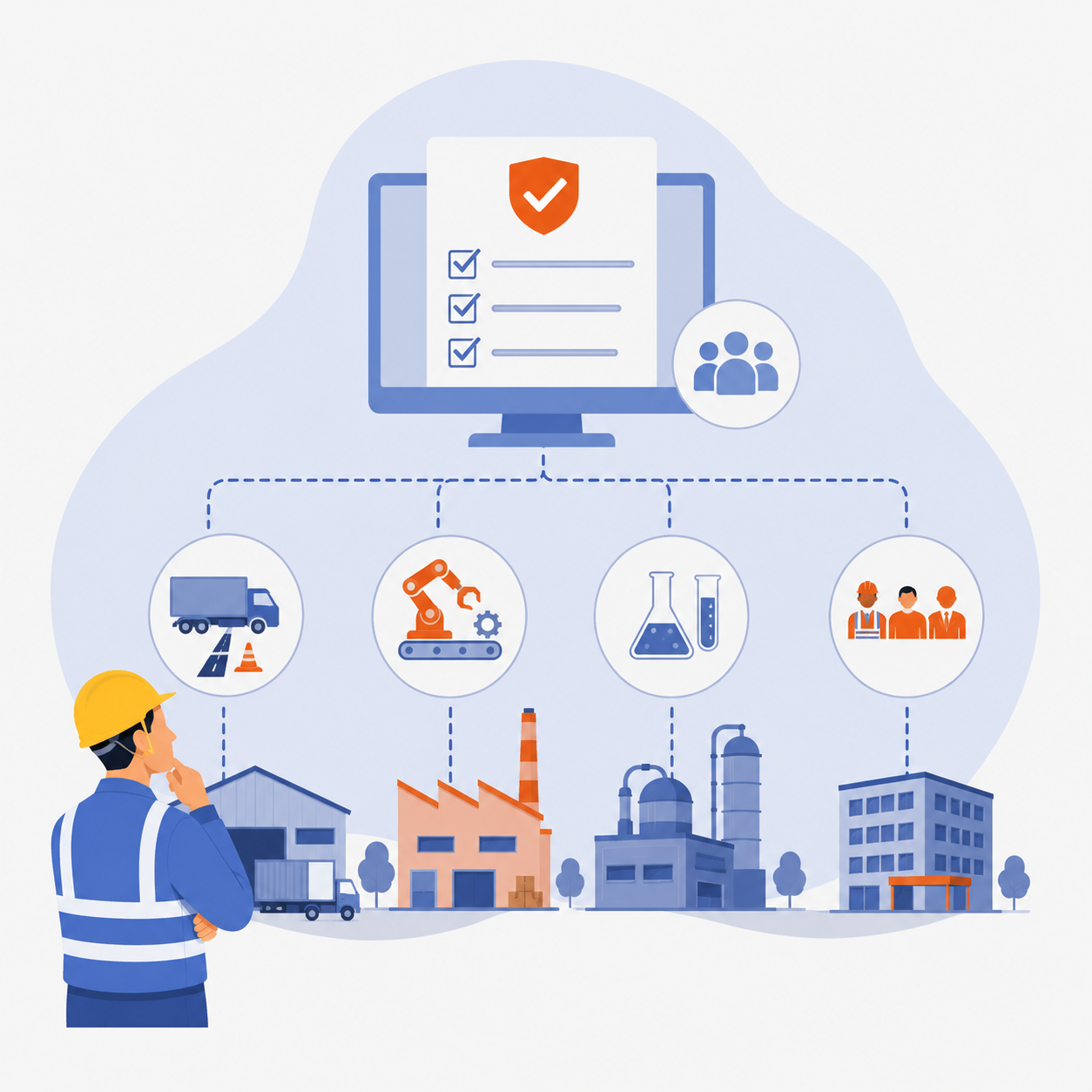
Two sites can share the same objectives without sharing the same risks
One of the most common mistakes is confusing standardization with uniformity.
EHS objectives are often shared across the organization:
- protecting employees;
- reducing risk;
- improving compliance;
- strengthening the safety culture.
Operational realities, however, can vary significantly from one facility to another. A distribution center does not face the same hazards as a manufacturing plant. A food processing facility operates under very different conditions than a chemical plant.
Even within the same industry, workflows, equipment, emergency procedures, and operational constraints may differ.
In this context, a fully standardized Safety Induction program can quickly become too generic to provide meaningful value at every site.
The audiences are not the same
The differences go beyond facilities and operations, they also involve the people who complete the Safety Induction.
Some sites primarily welcome employees, others work daily with contractors, drivers, visitors, or temporary workers: each audience has different information needs.
Drivers need to quickly understand traffic routes, loading and unloading procedures, and site access rules.
Contractors need to understand contractor coordination requirements, work procedures, and the hazards specific to their work areas.
New employees, on the other hand, need a broader introduction to the site’s work environment.
When a single Safety Induction attempts to address all of these audiences at once, it often becomes too broad to remain truly relevant.
The risk of making Safety Induction too generic
To ensure consistency across multiple sites, some organizations choose to centralize their Safety Induction content as much as possible. This approach offers clear advantages from a governance perspective.
However, when taken too far, it can also produce unintended consequences. In trying to speak to everyone, the message gradually loses its connection to day-to-day operations.
As a result, users receive broad corporate safety information without always recognizing the situations they are actually likely to encounter on site.
In practice, people are far more likely to remember information that is directly connected to their own work environment.
The less relevant the content feels to their daily responsibilities, the less attention they tend to pay.
Site teams need to maintain a degree of autonomy
This is a common challenge in multi-site EHS projects: corporate EHS managers are looking for consistency, local EHS managers are looking for operational relevance.
These objectives are not in conflict, they simply address different needs.
Site teams have first-hand knowledge of their facilities, including:
- high-risk areas;
- traffic patterns;
- recurring hazards;
- recent lessons learned;
- the challenges contractors and employees encounter on site.
When they can no longer adapt certain messages to reflect their site’s reality, the Safety Induction gradually becomes less effective. On the other hand, giving every site complete freedom can make it difficult to maintain consistency across the organization.
The challenge is to strike the right balance between a common framework and local customization.
Standardize the foundation, customize the rest
The most successful organizations rarely try to deliver exactly the same Safety Induction content everywhere.
Instead, they distinguish between two levels.
The first is the organization’s common foundation:
- safety values;
- life-saving rules or core safety rules;
- shared EHS requirements;
- prevention principles.
The second covers site-specific information:
- site-specific hazards;
- local procedures;
- traffic routes;
- restricted areas;
- contractor coordination requirements.
This approach maintains consistency across the organization without sacrificing operational relevance. Site teams benefit from a common framework while retaining the flexibility to adapt certain content to their own operating environment.
The goal isn’t to deliver the same message everywhere
In a multi-site environment, the effectiveness of a Safety Induction program depends on more than consistency alone.
It also depends on its ability to speak directly to the people taking it.
Standardizing EHS practices is essential.
But standardization does not mean uniformity.
Organizations that successfully build a consistent safety culture across multiple sites are often those that recognize a simple reality: the core principles can be shared, but the way they are presented should reflect each site’s operational environment.
Finding this balance is what makes it possible to deliver Safety Induction programs that are consistent, easy to understand, and genuinely relevant for employees, contractors, drivers, visitors, and temporary workers.
At Didactum, this challenge is at the heart of every multi-site Safety Induction project. Our platform enables organizations to build a common induction framework while tailoring specific content to each facility, audience, and local risk profile. Whether the learner is an employee, contractor, temporary worker, driver, or visitor, each Safety Induction can include the information that matters most to their role and work environment. The objective is not to standardize everything. It is to deliver a consistent learning experience while ensuring that every participant receives information that is relevant, practical, and aligned with the realities of the site they are visiting.
Ready to digitalize your prevention plans?
At didactum, for 30 years, we have been supporting EHS teams through this transformation by offering a SaaS platform designed for the realities of the industrial field. If you would like to discover how to simplify the management of your prevention plans while strengthening your compliance, contact our team to discuss your needs.
We put this expertise to work to guide you through your Safety Induction digitalization project
Our experts are of course available to support you every step of the way.
Contact us today for a personalized consultation and discover how our solutions can precisely meet your needs.
FAQ
Digitalizing safety induction helps save time, streamline site access flows, and track the validation of safety instructions. Didactum enables industrial sites to replace paper-based inductions with digital workflows tailored to real-world operations.
Content can vary depending on the user profile, language, site, specific risks, or type of work. Didactum enables you to create tailored workflows while maintaining a consistent safety framework.
Traceability relies on tracking logins, completed modules, quiz results, and validation of knowledge. Didactum enables EHS teams to quickly access the records required for monitoring and audits.
The main benefits include reduced manual tasks, better management of site access flows, content that is easier to update, and more reliable tracking of validations. didactum simplifies the management of safety induction at industrial sites.
 Contact us