
Knowledge assessment during Safety Induction: how to verify temporary workers’ understanding
A worker can complete a Safety Induction without having properly understood the essential safety instructions. A temporary worker may review all the content provided and still struggle to identify a hazard, apply a preventive measure, or respond appropriately to a risky situation.
Knowledge assessment goes beyond simply tracking whether content has been viewed. The challenge is to design assessments that verify the expected learning outcomes and ensure that the results lead to concrete actions.
How can you build an effective assessment, define consistent validation criteria, and use the results to improve Safety Induction?
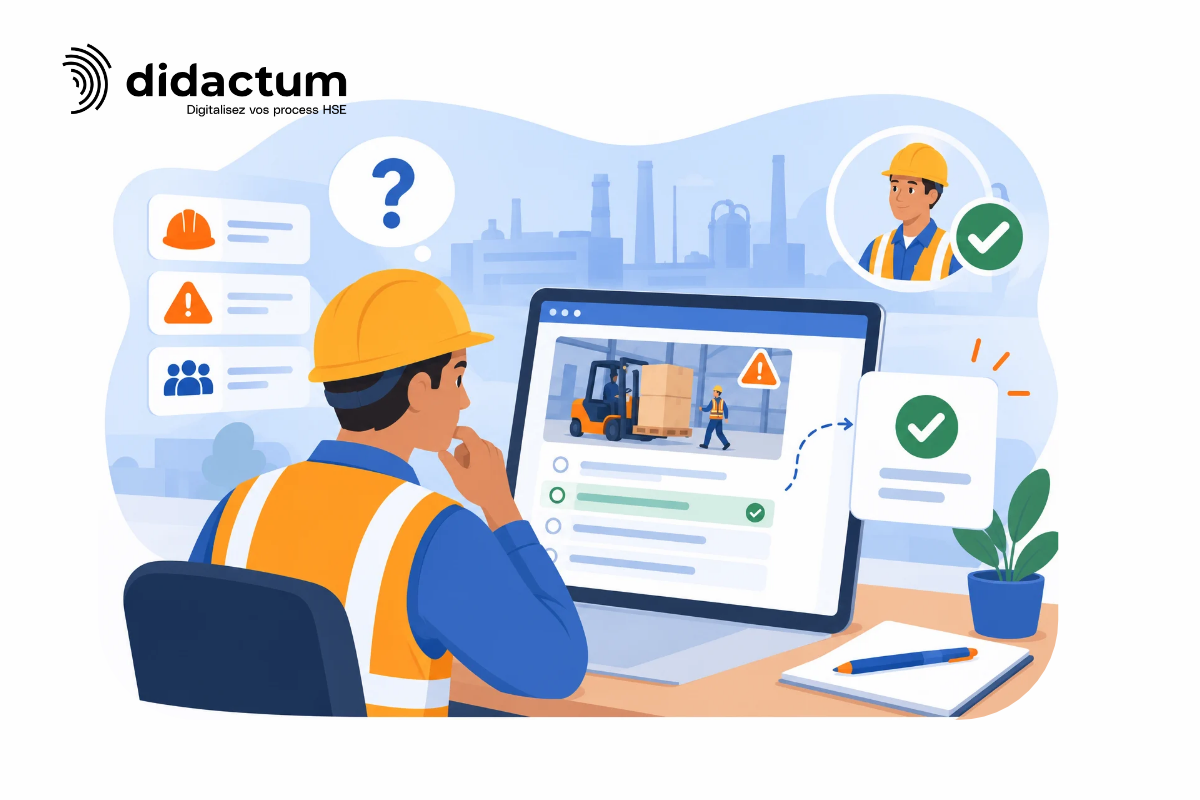
Determine what the assessment needs to verify
Before writing questions, it is essential to define what temporary workers should know by the end of their Safety Induction. Without this preliminary objective, a questionnaire may end up testing the memorization of secondary information rather than understanding of the most important safety instructions.
The first step is to review the risks identified in the Safety Induction learning path and the associated preventive measures. For each topic, determine what the person should be able to recognize, understand, or do.
The assessment may aim to verify whether the temporary worker can:
- identify a hazard associated with their work activities;
- recognize a safety instruction applicable to their work situation;
- choose the appropriate response to a risk or incident;
- identify whom to contact when in doubt or when an unusual situation arises.
These objectives must be directly linked to the Safety Induction content. If an instruction is considered essential, it must be clearly presented in the learning path and assessed appropriately.
This approach also helps prioritize questions. Not all information is equally important: the assessment should focus on knowledge needed to prevent risks rather than details that do not demonstrate whether safety instructions have been understood.
Write questions that reflect real work situations
Once the objectives have been defined, the next step is to develop questions that genuinely assess the expected knowledge. Wording plays a decisive role here: an ambiguous question can lead to an incorrect answer without necessarily indicating that the person misunderstood the instruction.
Questions should therefore use clear language and allow only one reasonable interpretation. Technical terms should be used when necessary, but understanding should not depend on unnecessarily complex vocabulary.
Where appropriate, scenario-based questions can go beyond simply recalling information. Instead of asking temporary workers to repeat a rule, you can present a situation and ask them how they should respond.
For example, a question might ask what action to take when a hazardous situation is identified during a work activity. The goal is to verify whether the person can recognize the situation and identify the expected response.
A few principles can help improve question quality:
- One question per objective: each question should assess a clearly defined piece of knowledge.
- Unambiguous answers: the expected answer should be supported by an instruction presented in the learning path.
- Plausible distractors: incorrect answers should reflect possible misunderstandings, without attempting to trick the person.
- Appropriate difficulty: the question should assess the intended knowledge, not the person’s ability to decipher complex wording.
It is also useful to review questions before they are released. Having someone familiar with the risks review them can help identify unclear wording and ensure that the expected answers match the applicable safety instructions.
Define consistent validation criteria
Once the questionnaire has been developed, the next step is to determine what result is required for Safety Induction to be considered successfully completed.
A passing score helps formalize this decision. However, it should not be chosen simply to achieve a satisfactory pass rate. It must be consistent with the objectives of Safety Induction and the type of knowledge being assessed.
An overall score can indicate how well the content has been understood, but it is not always enough to determine whether every essential instruction has been understood. A temporary worker may achieve a satisfactory score while answering a question about a particularly significant risk incorrectly.
It is therefore useful to distinguish between two levels of assessment:
- Overall score: determines whether the required passing level has been achieved.
- Critical knowledge: verifies that priority safety instructions have been understood, even when the overall score is satisfactory.
This distinction should be established before the questionnaire is introduced. The validation criteria, any specific requirements for certain questions, and the conditions under which Safety Induction must be completed further should all be clearly defined.
These rules must remain consistent with the requirements applicable to the assignment and the Safety Induction process. The goal is not to multiply criteria, but to establish a clear method for determining whether the expected knowledge has been adequately assessed.
To explore this topic further, watch the replay of our webinar on digitalizing Safety Induction for temporary workers, featuring EOL Intérim’s experience. The webinar provides further insight into the challenges encountered in the field.
Plan what happens when results are insufficient
An insufficient score should not be treated as merely a statistical result. It should trigger an appropriate action to help the temporary worker understand their mistakes and review instructions that have not been properly understood.
To achieve this, the response to a failed assessment must be defined in advance. Depending on the process in place, several actions may be planned:
- Identify the questions the temporary worker answered incorrectly.
- Allow them to review the corresponding content.
- Provide additional explanations when certain instructions appear to have been misunderstood.
- Offer another assessment attempt.
- Verify that the validation criteria have been met before considering Safety Induction complete.
This approach prevents assessment from becoming a series of attempts repeated until the required score is achieved. A second attempt should be part of a process focused on understanding and correcting mistakes.
The approach should also reflect the risks involved. A misunderstanding of an essential safety instruction may require a specific verification rather than simply allowing the person to review the questionnaire again.
EOL Intérim’s experience illustrates the value of establishing clear rules. The process presented during our webinar used a 17-question assessment, with a passing threshold of 10 correct answers and another attempt available if the worker did not pass.
Use assessment results to improve Safety Induction
Assessment does not end with individual validation. The answers collected can also help EHS teams identify content that needs clarification or improvement.
When several temporary workers repeatedly answer the same question incorrectly, it is worth investigating why. The issue may stem from unclear wording, insufficiently explicit content, or difficulty understanding the situation presented.
Results analysis should therefore go beyond the overall pass rate. Several indicators can be useful:
- questions that generate the most errors;
- knowledge areas where difficulties recur;
- the frequency of additional assessment attempts;
- content that requires further explanation or adjustment.
This information can then guide updates to Safety Induction learning paths. A frequently misunderstood question may indicate a need to rephrase the question or expand the content. Conversely, improved results after updating a resource can help assess whether the change has been effective.
However, these data must be interpreted carefully. An incorrect answer alone does not reveal the cause of the mistake. Results should serve as a starting point for further analysis and improvements to Safety Induction, rather than as a comprehensive measure of how well risks are managed in the field.
An effective assessment helps determine the next steps
Designing an effective knowledge assessment for Safety Induction requires clearly defining the expected learning outcomes, writing questions that reflect real work situations, and establishing consistent validation criteria. It also means planning what to do when results are insufficient and using the answers to improve content over time.
The didactum SaaS platform allows organizations to integrate quizzes into Safety Induction learning paths, assess participants’ knowledge, and centralize results. Teams can track completion and validation, identify learning paths that require particular attention, and access useful information to manage their process. Assessment thus becomes part of a structured learning path, from delivering safety instructions to tracking whether they have been understood.
Prêt(e) à vous lancer dans la digitalisation de votre Accueil Sécurité ?
At didactum, for 30 years, we have been supporting EHS teams through this transformation by offering a SaaS platform designed for the realities of the industrial field. If you would like to discover how to simplify the management of your prevention plans while strengthening your compliance, contact our team to discuss your needs.
We put this expertise to work to guide you through your Safety Induction digitalization project
Our experts are of course available to support you every step of the way.
Contact us today for a personalized consultation and discover how our solutions can precisely meet your needs.
Contact us today for a personalized consultation and discover how our solutions can precisely meet your needs.
FAQ
Digitalizing safety induction helps save time, streamline site access flows, and track the validation of safety instructions. Didactum enables industrial sites to replace paper-based inductions with digital workflows tailored to real-world operations.
Content can vary depending on the user profile, language, site, specific risks, or type of work. Didactum enables you to create tailored workflows while maintaining a consistent safety framework.
Traceability relies on tracking logins, completed modules, quiz results, and validation of knowledge. Didactum enables EHS teams to quickly access the records required for monitoring and audits.
The main benefits include reduced manual tasks, better management of site access flows, content that is easier to update, and more reliable tracking of validations. didactum simplifies the management of safety induction at industrial sites.
 Contact us