
How to coordinate staffing agencies and host companies for Safety Induction
Preparing temporary workers for Safety Induction involves several stakeholders. The staffing agency knows the worker’s profile and organizes their assignment. The host company understands the risks associated with its work environment, facilities, and the tasks the temporary worker will perform.
When these stakeholders operate without sufficient coordination, information may be missing, shared too late, or checked more than once. Organizing Safety Induction then becomes more difficult, particularly when assignments are urgent or several staffing agencies work with the same industrial site.
The challenge is to establish a clear process, from preparation in advance through arrival on site, so that each stakeholder can fulfill their role and access the information they need at the right time.
Clarify each stakeholder’s responsibilities
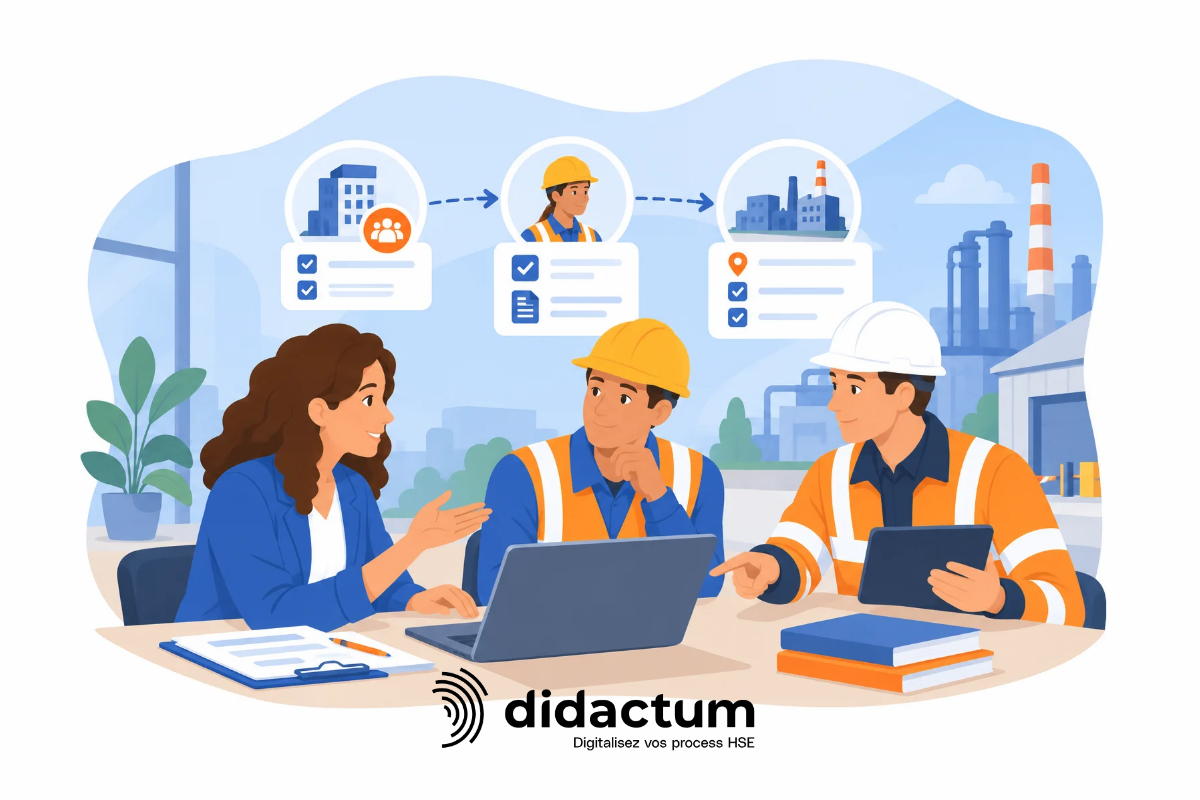
The first step is to determine who is responsible for each stage of the Safety Induction process. Without a clear allocation of responsibilities, some tasks may be overlooked while others are performed multiple times by different people.
Staffing agencies and host companies have complementary knowledge. The staffing agency can organize Safety Induction preparation in advance and provide the information needed for the learning path. The host company, in turn, must communicate relevant information about the assignment and its work environment, then carry out the prevention activities required at its site.
Responsibilities can be allocated according to the following principles:
L’agence de travail temporaire et l’entreprise utilisatrice disposent de connaissances complémentaires. L’agence peut organiser la préparation de l’accueil sécurité en amont et transmettre les informations nécessaires au parcours. L’entreprise utilisatrice doit, quant à elle, communiquer les éléments relatifs à la mission et à son environnement de travail, puis assurer les actions de prévention qui relèvent de son site.
Une répartition opérationnelle peut s’appuyer sur les principes suivants :
- Staffing agency: collect the information needed for preparation, direct the temporary worker to the appropriate Safety Induction learning path, and organize its completion.
- Temporary worker: complete the required learning path, review the safety instructions, and report any difficulties understanding the content or any missing information.
- Host company: provide relevant information about the assignment and site-specific risks, then organize on-site Safety Induction and communicate any specific instructions required before work begins.
This allocation must be adapted to the organization and the obligations applicable to each situation. It does not relieve any stakeholder of their own safety and prevention responsibilities.
The goal is not to transfer safety responsibility from one stakeholder to another, but to ensure their actions complement one another and clarify what each is expected to do.
Organize information sharing before the assignment
To prepare temporary workers for Safety Induction effectively, stakeholders need to receive the information required to determine the appropriate content sufficiently early.
However, staffing requests can be urgent, and assignment details are not always communicated with enough precision. A job title alone does not necessarily reveal the actual tasks, equipment used, or specific risks associated with the work.
It is therefore useful to define a standard set of information to be shared between the host company and the staffing agency. Depending on the requirements, this may include:
- the job role and assigned tasks;
- the main risks associated with the assignment;
- the required skills or qualifications and authorizations;
- specific instructions that must be understood before arriving on site;
- any particular aspects of the assignment that require additional preparation.
Information sharing must also be properly timed. The details needed to prepare Safety Induction must be available early enough to select the right learning path and give the temporary worker time to complete it.
It is useful to designate a contact person for each exchange and establish a procedure for situations where information is incomplete. This prevents uncertainty about an assignment from being addressed simply by sending generic content.
Finally, last-minute changes must be taken into account. If the assigned tasks change, stakeholders must be able to determine whether the original Safety Induction learning path is still appropriate or whether additional information is required.
Connect advance preparation with on-site Safety Induction
Safety Induction preparation completed before an assignment and the Safety Induction organized by the host company on site serve complementary purposes. Their relationship must be clearly defined to prevent omissions, without assuming that one can always replace the other.
Advance preparation allows certain information to be shared before arrival. This may include risks associated with the job role, general prevention principles, and instructions needed to understand the assignment.
On-site Safety Induction then addresses the specific characteristics of the actual work environment, including traffic routes, facilities, restricted-access areas, local procedures, emergency arrangements, and instructions specific to the work being performed.
It is therefore essential to distinguish between what can be covered remotely and what must be presented, checked, or explained on site. Completing preparation in advance should not lead to the assumption that the temporary worker automatically understands the risks specific to the site or the rules applicable to their position.
To ensure continuity, stakeholders can define several checkpoints:
- information that must be provided before arrival;
- steps whose completion must be verified;
- instructions that still need to be delivered on site;
- procedures for reporting a missing step or a situation requiring specific adjustments.
To explore this topic further, watch the replay of our webinar on digitalizing Safety Induction for temporary workers, featuring EOL Intérim’s experience. The webinar provides further insight into the challenges encountered in the field.
Formalize communication and responsibilities
A clear process must work in day-to-day operations, including when several staffing agencies, contacts, or sites are involved. Coordination rules must therefore be explicit enough that the process does not depend solely on individual habits or team members’ knowledge.
This can take the form of a shared procedure specifying the information to be communicated, the stages of Safety Induction, and the people responsible for each action.
It should answer four key questions:
- Who provides the information needed to prepare Safety Induction?
- Who selects the learning path and organizes its completion?
- Who verifies that the required steps have been completed?
- Who takes action when information is missing or an assignment changes?
It is also important to define which information must be accessible to each stakeholder. A staffing agency may need to know the status of a Safety Induction learning path, while the host company may need to verify that a required step has been completed before work begins.
Access to this information should reflect each stakeholder’s needs. The goal is to facilitate coordination, not to multiply exchanges or share information without an operational reason.
Finally, the procedure must address specific situations, such as urgent assignments, incomplete learning paths, difficulties understanding the content, or changes in job responsibilities. Teams then have shared rules for identifying discrepancies and determining the appropriate next steps.
Adapt the process to the number of temporary workers
Coordination may seem relatively straightforward when only a small number of people are involved. It becomes more complex when several staffing agencies supply workers to the same site, assignments follow one another rapidly, or Safety Induction must be organized across multiple facilities.
In this context, tasks must be allocated in a way that preserves oversight of essential information while limiting repetitive manual work.
Some activities require human expertise, particularly defining content, assessing risks, and approving safety instructions. Others can be structured and automated, such as sending Safety Induction learning paths, issuing completion reminders, or sharing status summaries.
This distinction allows teams to focus their attention on situations that genuinely require their involvement.
To keep the process efficient, it is useful to:
- standardize the common preparation steps;
- maintain consistent information-sharing rules for the stakeholders involved;
- centralize the information needed for tracking;
- automate repetitive tasks where appropriate;
- maintain a clear procedure for exceptions and urgent situations.
Coordination therefore depends on more than the quality of communication between individuals. It also depends on structuring the process so that it remains clear and practical as assignment volumes increase.
Effective Safety Induction relies on clear coordination between stakeholders
Safety Induction for temporary workers cannot be organized independently of the relationship between the staffing agency and the host company. Clear responsibilities, advance information sharing, and coordination with on-site Safety Induction are essential to maintaining continuity throughout the process.
By formalizing the steps, identifying the people involved, and defining the actions to take when something goes wrong, stakeholders can establish a common framework that helps them coordinate their efforts, prevent omissions, and track Safety Induction learning paths more effectively.
To support this process, the didactum SaaS platform enables organizations to structure Safety Induction learning paths, distribute them to the relevant people, and centralize information about completion and validation. Tracking and reminder features give teams greater visibility, while structured content helps coordinate the different stakeholders involved. The solution supports the Safety Induction process without replacing the prevention responsibilities of either the staffing agency or the host company.
Prêt(e) à vous lancer dans la digitalisation de votre Accueil Sécurité ?
At didactum, for 30 years, we have been supporting EHS teams through this transformation by offering a SaaS platform designed for the realities of the industrial field. If you would like to discover how to simplify the management of your prevention plans while strengthening your compliance, contact our team to discuss your needs.
We put this expertise to work to guide you through your Safety Induction digitalization project
Our experts are of course available to support you every step of the way.
Contact us today for a personalized consultation and discover how our solutions can precisely meet your needs.
Contact us today for a personalized consultation and discover how our solutions can precisely meet your needs.
FAQ
Digitalizing safety induction helps save time, streamline site access flows, and track the validation of safety instructions. Didactum enables industrial sites to replace paper-based inductions with digital workflows tailored to real-world operations.
Content can vary depending on the user profile, language, site, specific risks, or type of work. Didactum enables you to create tailored workflows while maintaining a consistent safety framework.
Traceability relies on tracking logins, completed modules, quiz results, and validation of knowledge. Didactum enables EHS teams to quickly access the records required for monitoring and audits.
The main benefits include reduced manual tasks, better management of site access flows, content that is easier to update, and more reliable tracking of validations. didactum simplifies the management of safety induction at industrial sites.
 Contact us