
How digital Safety Induction strengthens EHS compliance
In many industrial organizations, Safety Induction is still viewed as little more than an administrative step before employees, contractors, or visitors are granted access to a facility. In reality, it serves a much broader purpose. An effective Safety Induction helps organizations meet their EHS compliance requirements by ensuring that everyone entering the site understands the hazards they may encounter, the safety rules they must follow, and the behaviors expected of them.
For EHS managers, the challenge extends far beyond organizing induction sessions or distributing safety information. It is about ensuring that every worker receives the right information, understands the requirements relevant to their role, and that the organization can demonstrate a consistent and well-managed approach to risk prevention.
This is where digital Safety Induction delivers real value. Rather than simply replacing paper-based processes, it strengthens several key aspects of EHS compliance and operational risk management.
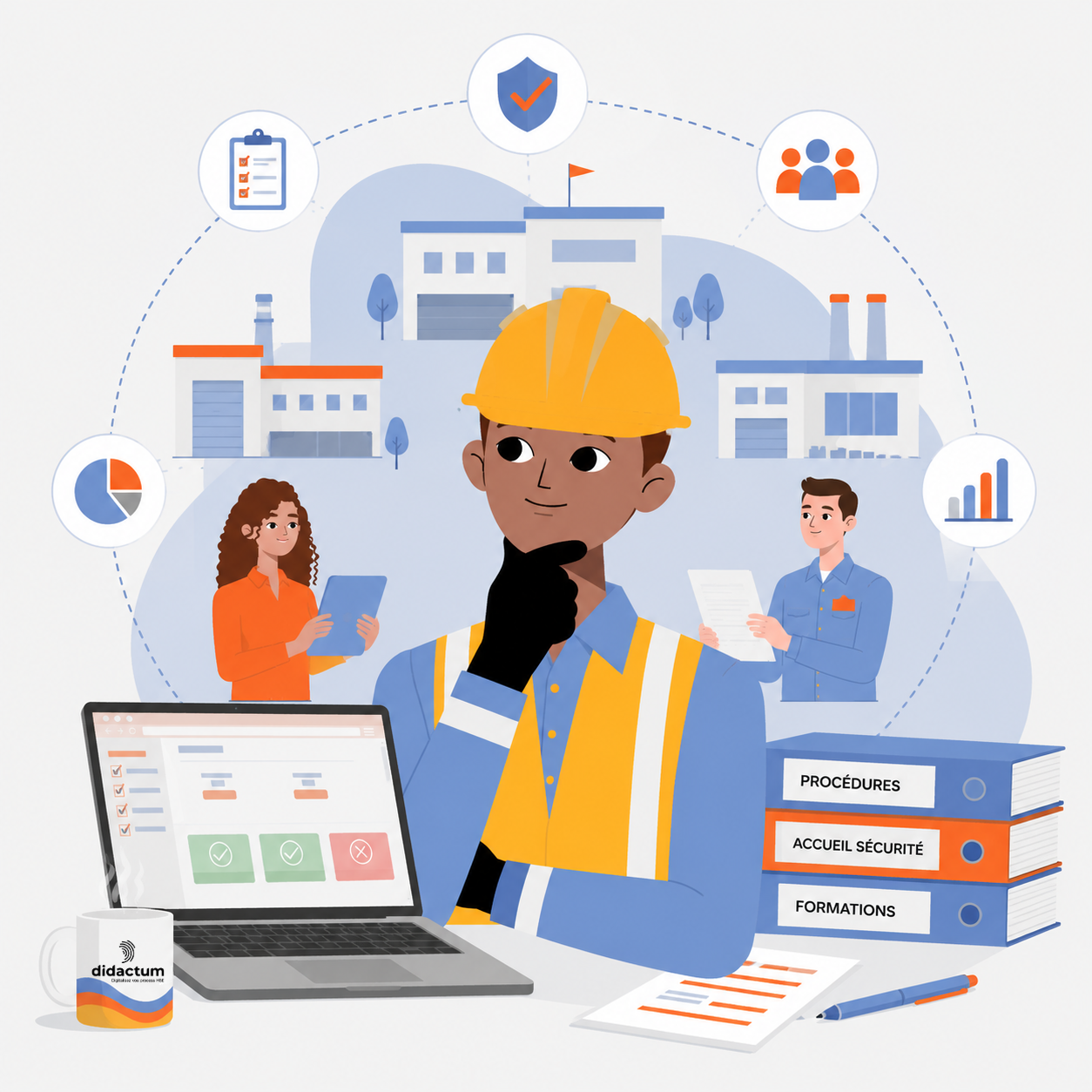
Safety Induction is a cornerstone of EHS compliance
Across industrial sectors, organizations are expected to take the necessary steps to protect the health and safety of everyone working on site.
These responsibilities typically include identifying workplace hazards, communicating safety requirements, and providing workers with the information and training they need to perform their jobs safely.
In practical terms, this means organizations must be able to identify the hazards present at their facilities, inform the people affected, and ensure they understand the safety requirements that apply to their work.
Safety Induction is a key part of this process. It introduces site-specific hazards, traffic rules, emergency procedures, required personal protective equipment (PPE), and the expected behaviors in restricted or high-risk areas.
For many industrial organizations, it represents the first practical step in their overall risk prevention strategy.
The challenge becomes even greater when contractors are involved
The need for an effective Safety Induction becomes even more critical when contractors work on an industrial facility.
Maintenance activities, capital projects, planned shutdowns, and specialized services often bring together large numbers of workers who may be unfamiliar with the facility, its procedures, or its specific hazards.
Managing these activities requires close coordination between the host organization and its contractors to ensure that everyone understands the site’s safety requirements before work begins.
In this context, Safety Induction is much more than an administrative requirement. It is a critical component of an organization’s overall EHS management system.
Many EHS managers face this challenge every day. When dozens—or even hundreds—of contractors need to be onboarded each month, ensuring that every individual receives accurate, consistent, and up-to-date information becomes a major compliance priority.
Compliance is about more than simply providing information
For many years, the primary objective was simply to demonstrate that a Safety Induction had been completed.
A signed attendance record or completion certificate was often considered sufficient proof that someone had participated in an induction session.
Today, expectations have evolved.
During an audit, certification assessment, customer review, or incident investigation, the focus is no longer just on whether a Safety Induction took place. It is also on how effective the process was.
Was the information relevant to the individual’s role?
Was the content up to date?
Were the critical safety requirements communicated effectively?
Can the organization demonstrate that its Safety Induction process is consistent, controlled, and well managed?
As a result, compliance has become much more than simply maintaining proof that someone attended an induction session.
Reducing inconsistencies and improving process control
This is one of the greatest advantages of digitalization.
With traditional approaches, inconsistencies often develop over time. A presentation is updated at one facility but not another. A procedure changes without being communicated everywhere. An approval is missed. A document can no longer be found months after it was created.
In most cases, these issues are not caused by a lack of attention from EHS teams. They are the natural consequence of processes becoming increasingly difficult to manage as organizations grow, handle larger volumes, or operate across multiple facilities.
Digitalization helps reduce these inconsistencies by creating a more structured and standardized process. Content is centralized, updates are easier to manage, and approval workflows are applied more consistently.
This standardization directly strengthens overall EHS compliance.
Verifying that safety requirements are understood
EHS compliance also depends on an organization’s ability to communicate information that people can clearly understand and apply in their daily work.
Simply providing safety information does not guarantee that it has been understood.
This challenge is especially common in organizations that work with temporary workers, contractors, drivers, or international teams. Many EHS managers recognize how difficult it can be to ensure that everyone fully understands the site’s critical safety requirements before arriving on site.
Digital Safety Induction programs can incorporate knowledge assessments, role-specific learning paths, and multilingual content to better address these challenges.
The objective is not to turn Safety Induction into an examination. It is to improve the quality of the information being delivered and reduce the risk of someone beginning work without fully understanding essential safety requirements.
Simplifying audits and demonstrating compliance
Traceability remains a key component of EHS compliance.
Whether preparing for an ISO 45001 audit, a customer audit, an internal review, or a regulatory inspection, organizations need to quickly access the records that demonstrate their Safety Induction process is being applied consistently.
Digitalization makes this much easier by centralizing information related to completed inductions, approvals, completion records, and renewal dates.
However, traceability is valuable because it supports a broader, well-managed process. It is not an objective in itself. Instead, it provides evidence that the organization is consistently applying the risk prevention measures it has put in place.
Digitalization as a driver of EHS compliance
Organizations that digitalize their Safety Induction process are not simply looking to save time or reduce administrative workload.
Above all, they want greater control over a process that plays a critical role in their overall risk prevention strategy.
By making it easier to deliver the right information, standardizing processes, reducing the risk of errors or omissions, strengthening knowledge validation, and simplifying compliance documentation, digitalization directly contributes to stronger EHS compliance.
As regulatory requirements continue to evolve, audits become more demanding, and customers place greater emphasis on contractor safety, digital Safety Induction is becoming an essential tool for improving risk management and supporting a proactive safety culture.
Building a sustainable compliance strategy
A successful Safety Induction digitalization project depends on more than implementing new technology. It requires building a program that supports compliance, reflects each facility’s operational realities, and remains simple enough to manage on a daily basis.
This is the approach didactum takes with industrial organizations. We work alongside EHS managers to design Safety Induction programs that support compliance objectives while adapting to the operational requirements of each facility. By tailoring learning paths to different audiences and site-specific risks, organizations can strengthen compliance, improve the onboarding of employees and contractors, and implement a Safety Induction process that is easier to manage over the long term.
Ready to digitalize your prevention plans?
At didactum, for 30 years, we have been supporting EHS teams through this transformation by offering a SaaS platform designed for the realities of the industrial field. If you would like to discover how to simplify the management of your prevention plans while strengthening your compliance, contact our team to discuss your needs.
We put this expertise to work to guide you through your Safety Induction digitalization project
Our experts are of course available to support you every step of the way.
Contact us today for a personalized consultation and discover how our solutions can precisely meet your needs.
FAQ
Digitalizing safety induction helps save time, streamline site access flows, and track the validation of safety instructions. Didactum enables industrial sites to replace paper-based inductions with digital workflows tailored to real-world operations.
Content can vary depending on the user profile, language, site, specific risks, or type of work. Didactum enables you to create tailored workflows while maintaining a consistent safety framework.
Traceability relies on tracking logins, completed modules, quiz results, and validation of knowledge. Didactum enables EHS teams to quickly access the records required for monitoring and audits.
The main benefits include reduced manual tasks, better management of site access flows, content that is easier to update, and more reliable tracking of validations. didactum simplifies the management of safety induction at industrial sites.
 Contact us