
Deploying an EHS tool across multiple sites: why the “big bang” approach has its limits
When an organization decides to digitalize its EHS processes, a tempting idea often emerges early on: roll out the new tool across all sites at once and quickly gain a consolidated view at the organization level.
On paper, this approach seems efficient. So why deploy a tool gradually if all sites are supposed to follow the same processes?
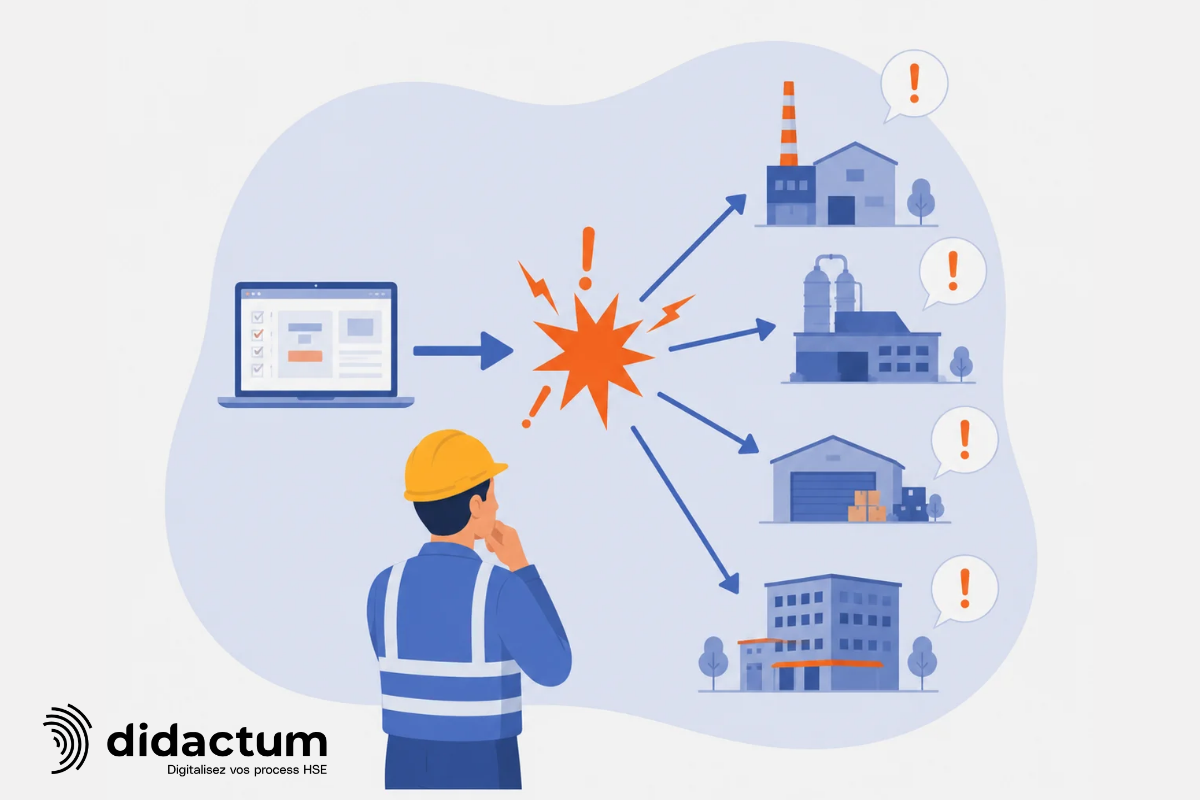
In practice, projects launched simultaneously across multiple facilities often encounter challenges that teams did not anticipate. Not because the tool is unsuitable, but because sites are rarely as consistent as they may appear.
Not all sites start from the same point
This is often the first reality that projects uncover. Even within the same organization, facilities rarely have the same level of maturity. Some already have well-structured processes, while others still rely on more improvised tools or practices largely based on team experience.
The number of contractors and other workers involved can also vary significantly, as can operational constraints. One site may work with thousands of contractors every year, while another primarily manages permanent employees. The needs may seem similar, but the operational realities are often very different.
When all sites transition simultaneously, these differences quickly become apparent.
Challenges emerge everywhere at the same time
One theoretical advantage of a full-scale rollout is speed. But this speed also creates a side effect that is rarely anticipated.
Questions arise all at once, support requests come in simultaneously, and every adjustment becomes urgent.
Project teams then find themselves managing several operational realities in parallel. A challenge at one site may require a specific solution, while another may affect only certain user groups or processes. The support workload can increase dramatically, turning what initially seemed like a time-saving approach into an additional source of complexity.
Differences between sites become more visible
The rollout also reveals differences that may not have been apparent during the preparation phase. Some teams already follow practices closely aligned with the target model, while others need to change a significant part of their established workflows. Similarly, some EHS managers embrace the project immediately, while others need more time to adopt new ways of working.
These differences are normal. But when they emerge everywhere at once, they become more difficult to analyze and address.
Project teams then spend a large part of their time managing the consequences of the rollout rather than supporting users in a structured and manageable way.
An organization-wide project needs to learn before scaling up
This is precisely why many organizations now favor a more gradual approach. The goal is not to slow down the project, but to create room for learning.
A first site makes it possible to observe actual usage, understand the challenges encountered, and identify features that are rarely used in order to detect potential friction points.
These insights then become extremely valuable when preparing subsequent rollouts. They allow the project to mature progressively before being extended on a larger scale.
Speed is not always the best measure of success
In EHS digitalization projects, rollout speed is easy to measure. However, it is much harder to assess how well teams actually adopt the tool. Yet this second measure often determines whether the project succeeds in the months following its launch.
Un outil déployé rapidement mais peu utilisé produit rarement les bénéfices attendus. À l’inverse, un déploiement progressif permet souvent de construire des usages plus solides et plus homogènes dans le temps.
The goal is therefore not to delay the transformation, but to give it the best chance of becoming firmly embedded in day-to-day practices.
Discover the Tepsa France case study on how to digitalize and harmonize safety induction across a group.
→ Discover the customer case study
A phased rollout for better results
The most robust multi-site EHS projects are not necessarily those that move the fastest. They are often the ones that acknowledge a simple reality: every site has its own context, constraints, and pace of adoption.
The project’s role is not to ignore these differences, but precisely to account for them and build a rollout that can operate sustainably across the organization.
In most cases, the real challenge is not making a tool available to every site on the same day. It is ensuring that the tool is genuinely used and adopted several months later.
Why didactum favors phased approaches
At didactum, multi-site projects generally begin with a pilot phase before any wider rollout. This approach allows EHS teams to observe actual usage, identify necessary adjustments, and establish a more robust framework before scaling up.
L’objectif n’est pas de ralentir le projet, mais de sécuriser son adoption. Les retours des premiers utilisateurs, les spécificités locales et les contraintes opérationnelles sont intégrés progressivement afin de préparer un déploiement plus fluide sur les autres établissements.
This approach often helps reduce differences in how the tool is used across sites while strengthening engagement among field teams.
Ready to start digitalizing your EHS processes?
For 30 years, didactum has been helping EHS teams through this transformation with a SaaS platform designed around the realities of industrial operations. If you want to simplify the management of your prevention plans while strengthening compliance, contact our team to discuss your needs.
We put this expertise to work to guide you through your digitalization project and help you digitalize your EHS processes.
Our experts are, of course, available to support you throughout this transformation.
Contact us today for a personalized consultation and discover how our solutions can precisely meet your needs.
FAQ
Digitalizing your EHS processes helps strengthen regulatory compliance, improve data traceability, and simplify document management. Didactum enables industrial sites to replace paper and Excel-based systems with more reliable digital workflows.
The most relevant processes include safety induction, prevention plans, driver safety protocols, permit-to-work, and safety training tracking. Didactum structures these processes within a SaaS platform designed for real-world industrial operations.
Digitalized EHS processes help reduce errors, duplicate entries, document loss, and manual follow-ups. With didactum, EHS teams gain better visibility, faster response times, and improved operational performance.
A strong EHS platform should centralize information, track approvals, simplify workflows, and provide clear visibility into ongoing processes. Didactum addresses these needs with a SaaS solution designed for industrial sites and real-world operational constraints.
 Contact us