
Multi-site EHS projects: 3 common mistakes and how to avoid them
When an industrial organization decides to standardize its EHS practices across multiple facilities, the project often seems straightforward on paper. The objectives are usually shared across the organization: improve visibility, standardize practices, strengthen traceability, and reduce the administrative workload for site teams.
Yet the first challenges often appear much earlier than expected.
One facility may already be using an HR system, while another still manages mandatory training and renewals across several Excel files. Some facilities may have well-structured EHS teams, while others rely on operational staff to support EHS activities. Safety Induction programs, training courses, and procedures may have the same names, but behind this apparent consistency are often very different operational realities.
This is precisely what makes multi-site EHS projects more complex than they initially appear.
Projects rarely fail because of a lack of commitment or because the technology is inadequate. Problems arise when organizations underestimate the differences in maturity between facilities and try to impose a single way of working without taking local operational realities into account.
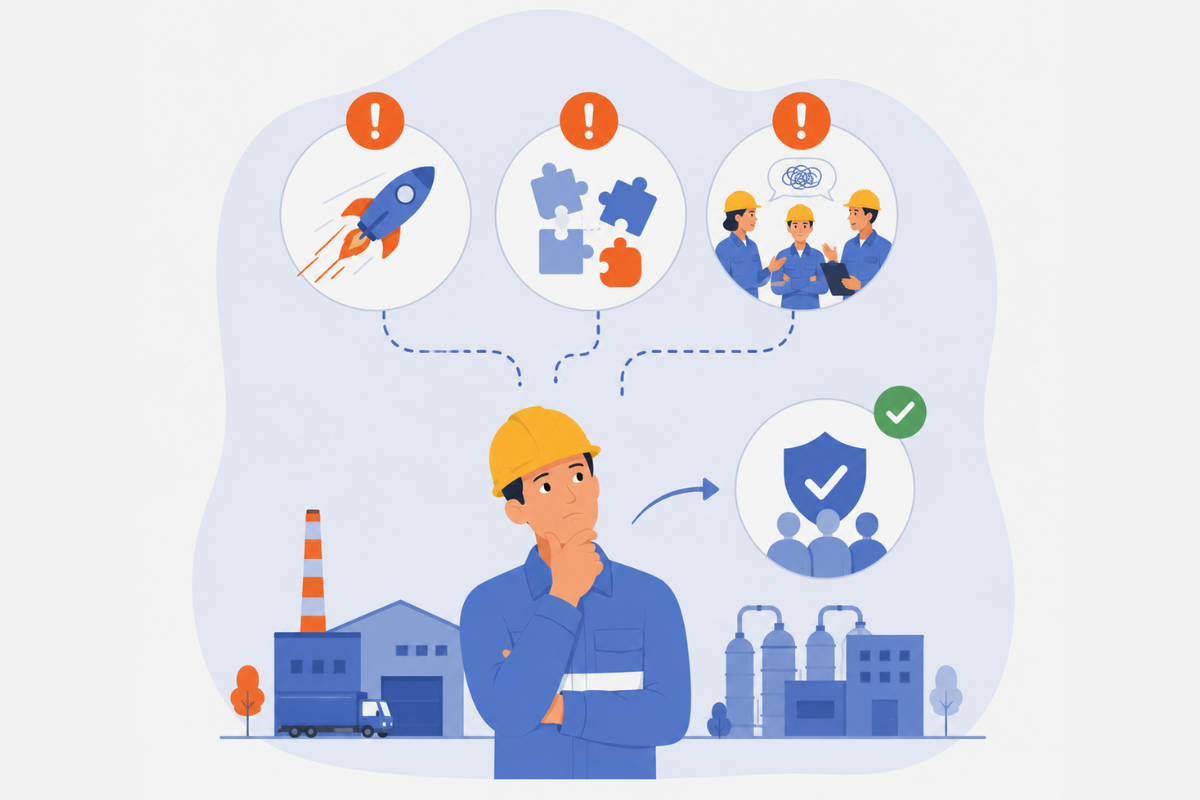
Mistake #1: trying to move too fast
In many multi-site projects, there is strong pressure to deliver results quickly. Once the decision has been made, it can be tempting to immediately roll out a new tool or process across all facilities.
The objective is understandable: standardize practices quickly and gain a consolidated view across the organization.
In reality, however, facilities rarely start from the same point.
One may already have structured processes in place. Another may still manage regulatory training renewals across multiple Excel files. Some EHS managers may be comfortable with digital tools, while others are primarily looking for a simple solution that does not add complexity to their daily work.
When these differences are overlooked, operational challenges quickly emerge. Problems encountered at one facility can then be replicated across the entire organization.
The issue is therefore not the speed of the project itself. It is the lack of a learning phase that allows the approach to be tested and adjusted before being rolled out more broadly.
Mistake #2: starting without a common framework
At the other end of the spectrum, some organizations want to preserve each facility’s autonomy and start their project without defining a shared foundation.
Each facility then keeps its own practices, documents, approval rules, and tracking methods.
This flexibility may seem convenient at first. However, it quickly becomes a barrier to effective management.
When each facility interprets the project’s objectives differently, the gaps between sites gradually widen. Data becomes difficult to compare, performance indicators lose consistency, and effective practices are harder to share across facilities.
The result is several different systems operating under the same corporate umbrella, without true standardization.
A multi-site project needs a common framework. Not to standardize every detail of local operations, but to establish shared rules that maintain consistency across the organization.
Mistake #3: ignoring day-to-day operational realities
This is probably the most common mistake.
In many projects, the target operating model is defined during planning meetings and then rolled out to users with the expectation that it will naturally fit into existing practices.
In reality, day-to-day operations rarely work exactly as planned.
Site teams may have to deal with unexpected arrivals of temporary workers, contractors who are only on site for a few hours, production constraints, or significant differences between facilities.
When a process introduces steps that users consider unnecessary or overly complex, they naturally look for ways to regain flexibility.
Some continue using their Excel spreadsheets alongside the new system. Others develop their own tracking methods or bypass certain steps in the process.
These behaviors do not necessarily indicate resistance to change. They often reveal a gap between the way the process was designed and the realities of day-to-day operations.
The greater this gap, the higher the risk that parallel processes and workarounds will emerge.
The consequences: loss of buy-in and credibility
When these challenges arise during the early stages of a project, the consequences quickly extend beyond the technical aspects.
Teams may feel that they are being asked to adopt a process designed without sufficient understanding of their operational reality. The expected benefits become harder to see, and user buy-in gradually declines.
From a management perspective, differences between facilities persist. Data becomes less reliable, comparisons become more difficult, and project resources are spent correcting misalignment rather than improving processes.
Over time, the credibility of the entire initiative can be undermined.
Build the framework before scaling
Multi-site EHS projects are about more than deploying a new tool.
They require organizations to align facilities with different constraints, established practices, and levels of digital maturity.
Successful initiatives rarely try to standardize everything immediately. Instead, they start by understanding operational realities, building a common framework that provides enough flexibility, and testing how the process works in practice before scaling it across the organization.
In a multi-site environment, success often depends less on how quickly a solution can be rolled out than on the ability to progressively build an approach that is accepted, practical, and usable across all facilities.
Ready to digitalize your EHS processes ?
At Didactum, for 30 years, we have been supporting EHS teams through this transformation by offering a SaaS platform designed for the realities of the industrial field. If you would like to discover how to simplify the management of your prevention plans while strengthening your compliance, contact our team to discuss your needs.
We put this expertise to work to guide you through your EHS digitalization project
Our experts are of course available to support you every step of the way.
Contact us today for a personalized consultation and discover how our solutions can precisely meet your needs.
FAQ
Digitalizing your EHS processes helps strengthen regulatory compliance, improve data traceability, and simplify document management. Didactum enables industrial sites to replace paper and Excel-based systems with more reliable digital workflows.
The most relevant processes include safety induction, prevention plans, driver safety protocols, permit-to-work, and safety training tracking. Didactum structures these processes within a SaaS platform designed for real-world industrial operations.
Digitalized EHS processes help reduce errors, duplicate entries, document loss, and manual follow-ups. With didactum, EHS teams gain better visibility, faster response times, and improved operational performance.
A strong EHS platform should centralize information, track approvals, simplify workflows, and provide clear visibility into ongoing processes. Didactum addresses these needs with a SaaS solution designed for industrial sites and real-world operational constraints.
 Contact us