
Structuring a phased EHS tool rollout without overwhelming teams
When an EHS digitalization project is launched, teams often face a particular challenge: implementing new tools, changing certain work habits, and supporting users, while continuing to handle the responsibilities that already fill their day-to-day work.
Unlike other transformation projects, EHS activities generally cannot be put on hold while the rollout takes place. Safety Inductions still need to be conducted, mandatory training still needs to be completed, audits continue, and contractors continue to work on site. Regulatory requirements do not disappear during the project.
The question therefore becomes very practical: how can practices evolve without adding a workload that teams will struggle to absorb?
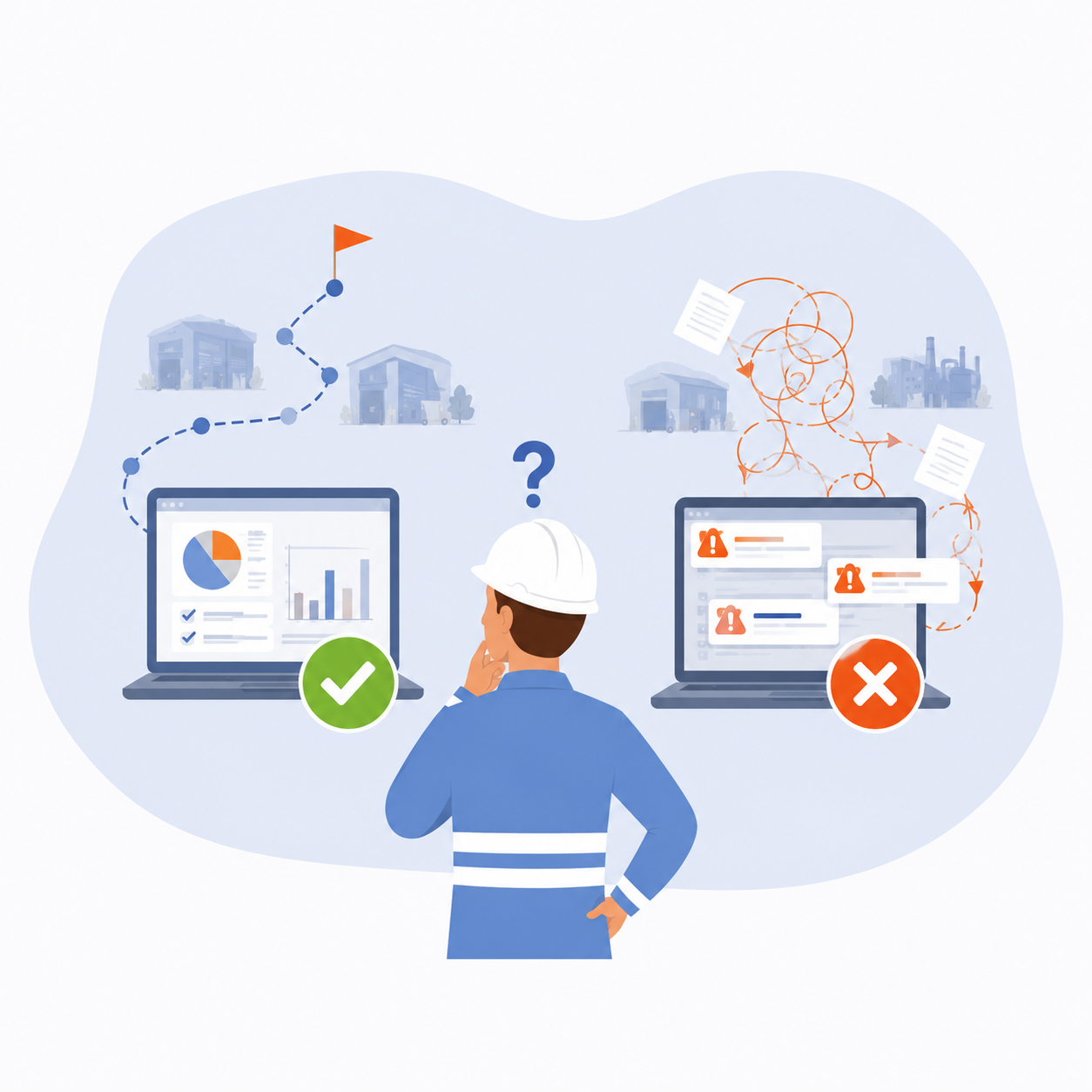
The project adds to users’ day-to-day workload
One of the challenges that is often underestimated is the teams’ actual availability. For users, the project does not immediately replace existing processes. At first, it is more likely to be added to their existing responsibilities.
EHS managers continue to ensure that safety requirements are followed in the field, managers remain focused on their operational priorities, and administrative teams must maintain existing processes. In this context, the time available to participate in workshops, test new ways of working, or learn a new tool remains limited.
The more a project requires significant involvement over a short period, the greater the risk of overload. Teams may then perceive the initiative as an additional constraint rather than as an improvement to their day-to-day work.
Why overly fast rollouts lead to fatigue
In some organizations, the desire to achieve results quickly leads to a large number of activities being concentrated into just a few weeks. Tool configuration, training sessions, meetings, data migration, user testing, and the implementation of new procedures can then follow one another at a rapid pace.
Even when this approach is driven by a desire for efficiency, it can quickly reach its limits. Users feel that they have to manage their regular responsibilities and the transformation project at the same time. This situation can create a form of fatigue that gradually reduces their availability and ability to adopt new ways of working.
The risk is not only that the project slows down. It can also reduce team engagement at the very point when their involvement is most important.
Break the project down into more manageable steps
Phased approaches are specifically designed to avoid this kind of overload. Rather than transforming all processes at the same time, they move forward through successive stages.
A first scope is deployed, users become familiar with the new workflows, and initial feedback helps identify the adjustments needed. Once this phase has stabilized, the project can gradually expand to other processes or sites.
This approach offers several benefits. Teams have more time to adopt new ways of working, issues are identified earlier, and benefits become visible before the project is fully completed. The change therefore feels more manageable and less disruptive.
Reduce the effort required from users
Successful projects are not necessarily those that require the greatest level of team involvement. They are often the ones that quickly demonstrate their ability to simplify certain day-to-day tasks.
When a user sees that they have fewer data entries to repeat, spend less time following up with certain stakeholders, or can access the information they need more easily, their perception of the project naturally changes. The tool is no longer seen as a new constraint, but as a solution to existing challenges.
This perception plays an essential role in the gradual adoption of new ways of working.
Identify the right times to deploy
The success of a rollout also depends on its ability to adapt to the actual pace of operations. Not every time of year is equally suited to the same level of team involvement.
Some sites have to deal with shutdowns, maintenance campaigns, major audits, or periods of peak activity that significantly limit team availability. Taking these constraints into account when preparing the project can help avoid unnecessary pressure and build a more realistic timeline.
A well-planned project is not necessarily the one that moves the fastest. It is often the one that best respects the capacity of the teams involved to absorb the change.
Make the field a partner in the rollout
Users play a central role in the success of a digitalization project. Their contribution should not, however, rely solely on a succession of requests or additional demands on their time.
The teams that are most engaged are generally those who understand the objectives being pursued and quickly see the benefits brought by the new organization. Field feedback then becomes a valuable source of continuous improvement, making it possible to adjust certain decisions as the rollout progresses.
Change is no longer driven solely by the project team. It gradually becomes a collective effort.
Roll out without slowing down operations
In EHS projects, rollout success is not measured solely by whether the initial timeline is met. It also depends on the organization’s ability to continue its activities without compromising operational efficiency.
Phased approaches make it possible to reconcile these two objectives. They provide the time needed for learning, limit team overload, and encourage more sustainable adoption of new ways of working.
Because in most organizations, the real challenge is not simply making a new tool available. It is successfully integrating it into teams’ day-to-day work without disrupting the activities that remain essential to the site’s operations.
How didactum supports phased rollouts
Projects supported by didactum are generally designed around the operational constraints specific to each site. Teams take into account periods of activity, available resources, and users’ level of maturity so that a digitalization project does not become an additional workload that is difficult to absorb.
The goal is to enable EHS managers and field teams to gradually adopt new ways of working while continuing their day-to-day activities, whether Safety Inductions, mandatory training, or contractor management.
Ready to start digitalizing your EHS processes?
For 30 years, didactum has been helping EHS teams through this transformation with a SaaS platform designed around the realities of industrial operations. If you want to simplify the management of your prevention plans while strengthening compliance, contact our team to discuss your needs.
We put this expertise to work to guide you through your digitalization project and help you digitalize your EHS processes.
Our experts are, of course, available to support you throughout this transformation.
Contact us today for a personalized consultation and discover how our solutions can precisely meet your needs.
FAQ
Digitalizing your EHS processes helps strengthen regulatory compliance, improve data traceability, and simplify document management. Didactum enables industrial sites to replace paper and Excel-based systems with more reliable digital workflows.
The most relevant processes include safety induction, prevention plans, driver safety protocols, permit-to-work, and safety training tracking. Didactum structures these processes within a SaaS platform designed for real-world industrial operations.
Digitalized EHS processes help reduce errors, duplicate entries, document loss, and manual follow-ups. With didactum, EHS teams gain better visibility, faster response times, and improved operational performance.
A strong EHS platform should centralize information, track approvals, simplify workflows, and provide clear visibility into ongoing processes. Didactum addresses these needs with a SaaS solution designed for industrial sites and real-world operational constraints.
 Contact us