
Safety Induction: how to prevent it from becoming a bottleneck at the site entrance
Safety Induction must meet a simple requirement: no one should enter a site without receiving the information they need to stay safe. However, the process can quickly become more complex when arrivals increase and people entering the site have different needs and constraints.
An employee may prepare for their visit several days in advance. A visitor may arrive for a one-time visit. A contractor may schedule their work in advance. A truck driver, on the other hand, may arrive at the security gate with only a few minutes to spare for entry formalities.
If all these situations are handled in the same way, Safety Induction can place an unnecessary burden on the teams at the entrance and slow down traffic.
The challenge is therefore not just to communicate the right safety instructions. It is also to ensure that delivering them fits naturally into the entry process.
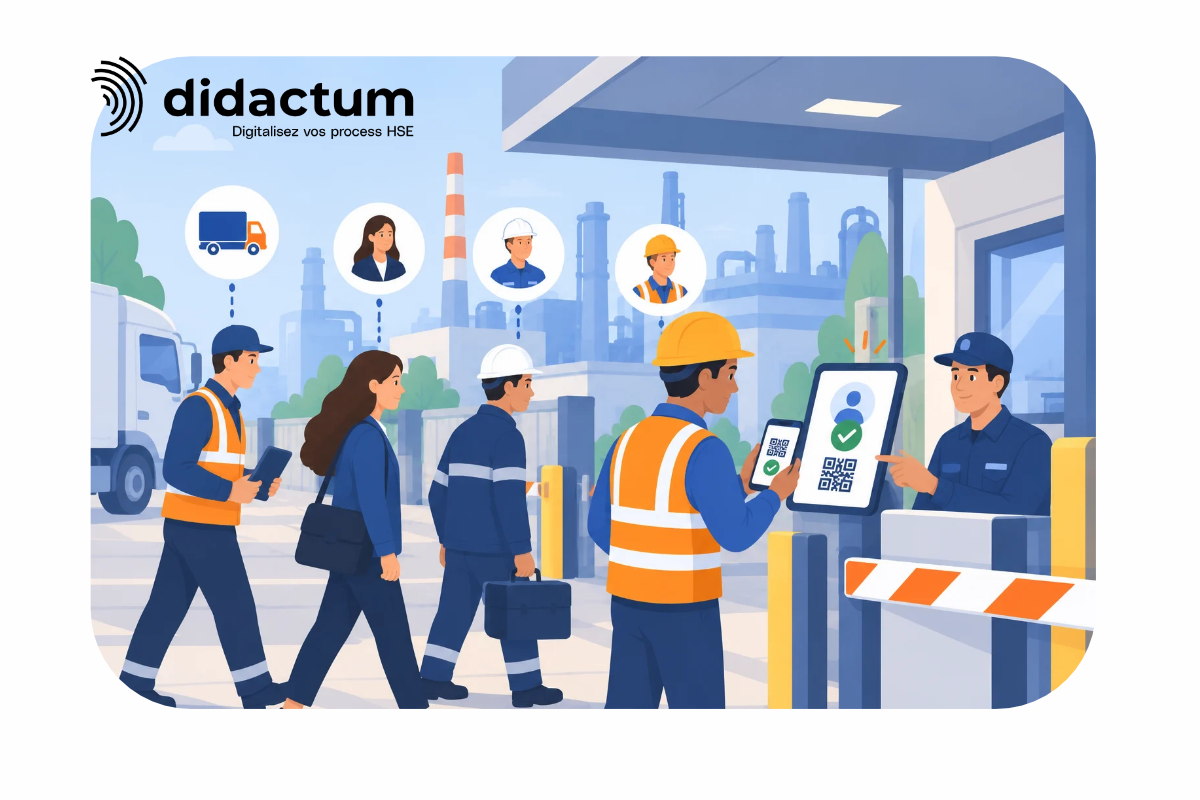
Not everyone arriving on site can follow the same process
The instinct may be to design a single induction process for everyone entering the site. Yet their constraints and levels of exposure to risk may differ.
An employee who works on site every day does not have the same needs as a visitor staying for a few hours. A contractor may require a more comprehensive induction depending on the work being performed, while a truck driver must be able to review the essential rules within a limited time.
The process should therefore be designed around the situations that actually occur: who is arriving, how long they will be on site, what information they need to know, and when they can review it.
This approach makes it possible to adapt the induction process without compromising the shared prevention framework.
Move Safety Induction earlier in the process whenever possible
One way to streamline arrivals is to avoid waiting until someone reaches the security gate to begin their Safety Induction.
When a visit is planned in advance, the induction can be sent ahead of time. Employees and contractors then have the time they need to complete it before arriving on site.
When they arrive, the goal is no longer to have them complete the entire process, but simply to verify that they have done so. Safety Induction and site entry thus become two connected steps that do not necessarily need to take place at the same time.
This approach helps reduce the number of inductions conducted in person and prevents the teams at the entrance from having to handle the entire workload.
Plan for situations where Safety Induction has not been completed
However, an effective process cannot rely solely on the ideal scenario.
Someone may arrive without having completed Safety Induction in advance. In this case, the process must make it possible to handle the situation without turning the entrance into a bottleneck.
Safety Induction can then be integrated directly into the security gate workflow. After checking the person’s status, the security officer can verify whether the induction has already been completed. If not, the person can complete it on site using a kiosk or a QR code on their smartphone before entering the facility.
This option changes how the process works: digitalization is not just a way to move Safety Induction online before arrival. It also provides a solution when the process could not be completed in advance.
Make the entrance a checkpoint
For this approach to work, the people responsible for managing arrivals must be able to quickly verify each person’s status.
If Safety Induction has already been completed, they should be able to confirm this without asking the person to repeat the process. If it still needs to be completed, that status must be immediately visible so the person can complete the required steps.
Traceability then becomes part of day-to-day operations. Rather than relying on a paper quiz, a signature, and subsequent filing, the tracking system makes it possible to identify who completed Safety Induction and when.
Verification at the entrance is therefore not an additional administrative step. It becomes the link between Safety Induction completed in advance and access to the site.
Design a process that adapts to real-world conditions
An effective Safety Induction process depends on more than the quality of its content. It also depends on how well it fits the different situations encountered at the entrance.
Preparing the induction in advance when possible, allowing it to be completed on site when necessary, adapting the level of information to different audiences, and making completion easy to verify all help create a process that does not rely on a single approach.
Digitalization then takes on a different meaning. It is not simply about replacing paper materials or an in-person session with digital content. It is about making the process more flexible while maintaining a clear framework and proof of completion.
A well-designed Safety Induction process should not create an additional obstacle at the site entrance. It should fit naturally into the entry process, accommodate unexpected situations, and allow both site teams and incoming personnel to move through each step without disruption.
Prêt(e) à vous lancer dans la digitalisation de votre Accueil Sécurité ?
At didactum, for 30 years, we have been supporting EHS teams through this transformation by offering a SaaS platform designed for the realities of the industrial field. If you would like to discover how to simplify the management of your prevention plans while strengthening your compliance, contact our team to discuss your needs.
We put this expertise to work to guide you through your Safety Induction digitalization project
Our experts are of course available to support you every step of the way.
Contact us today for a personalized consultation and discover how our solutions can precisely meet your needs.
Contact us today for a personalized consultation and discover how our solutions can precisely meet your needs.
FAQ
Digitalizing safety induction helps save time, streamline site access flows, and track the validation of safety instructions. Didactum enables industrial sites to replace paper-based inductions with digital workflows tailored to real-world operations.
Content can vary depending on the user profile, language, site, specific risks, or type of work. Didactum enables you to create tailored workflows while maintaining a consistent safety framework.
Traceability relies on tracking logins, completed modules, quiz results, and validation of knowledge. Didactum enables EHS teams to quickly access the records required for monitoring and audits.
The main benefits include reduced manual tasks, better management of site access flows, content that is easier to update, and more reliable tracking of validations. didactum simplifies the management of safety induction at industrial sites.
 Contact us