
Safety Induction for temporary workers: how to structure your content ?
Identifying the risks a temporary worker will face is the first step. The next is organizing the information needed to provide Safety Induction that aligns with their assignment.
Between common safety instructions, risks specific to certain job roles, and the requirements of particular work activities, Safety Induction content can quickly multiply. Without a clear structure, teams risk duplicating materials, delivering redundant information, or struggling to keep content up to date.
The challenge is to build Safety Induction learning paths that combine a common foundation, supplementary modules, and formats suited to the people concerned, while keeping the overall structure simple to manage.
1. Build a common Safety Induction foundation
The first step is to identify the information that must be provided to all relevant temporary workers, regardless of their job role or assignment.
This common foundation helps organize essential messages and ensure a consistent approach to Safety Induction. It may include expected behaviors, how to report an unsafe situation, and what to do in the event of an incident.
To be effective, this foundation should follow a logical sequence. Information can be organized into a simple progression:
- Understand the context: introduce the work environment and the main safety considerations.
- Know the essential rules: explain the instructions and expected behaviors.
- Know how to respond: outline what to do in the event of an unsafe situation or incident.
- Identify the right contacts: explain whom to contact with questions or when difficulties arise.
It is also important to distinguish between information that remains stable and information that requires regular updates. This distinction makes content maintenance easier and reduces the risk of retaining outdated instructions.
The common foundation therefore serves as the basis for the learning path. However, it should not become so general that it attempts to cover every situation without addressing the specific needs of each assignment.
2. Add modules based on job roles and risks
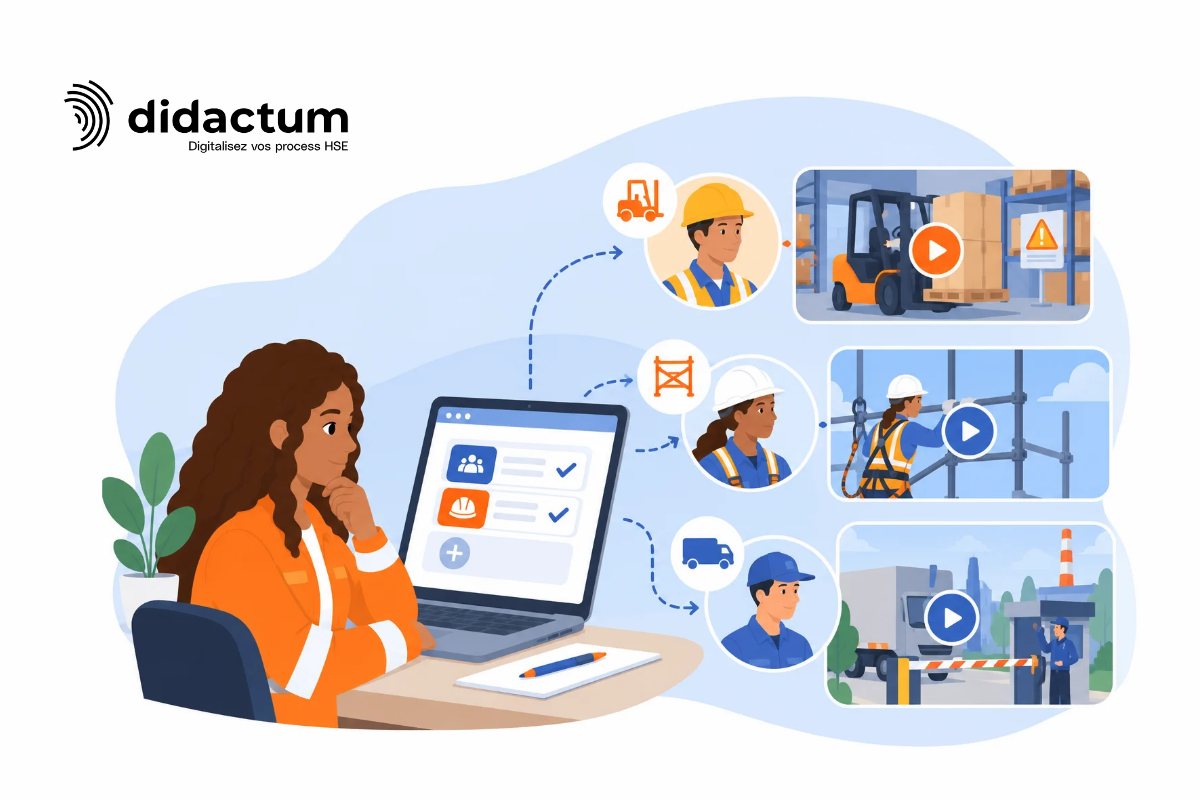
Once the common foundation has been defined, supplementary modules can be assigned to different profiles, job roles, or types of assignments.
This structure makes it possible to deliver specific information without having to rebuild each learning path from scratch. For example, a temporary worker assigned to material handling may receive additional content about the associated risks, while another worker may complete a module on working at height if their assignment requires it.
When structuring these modules, it is useful to start with the work situations identified during the needs assessment. Each piece of content should serve a specific purpose: explaining a risk, presenting a safety instruction, or preparing workers for a particular situation.
La construction des parcours repose alors sur trois principes :
- Reuse common content: avoid duplicating the common foundation in every learning path.
- Match the right modules to the right situations: link supplementary content to the relevant job roles and risks.
- Limit unnecessary information: include only content relevant to the defined learning path, without omitting instructions necessary for prevention.
This modular approach also makes future updates easier. When specific content needs to be changed, teams can update the relevant module without revising every learning path, provided the structure allows changes to be applied consistently.
The goal is therefore not to create a different learning path for every temporary worker, but to build a structure in which content can be combined according to specific needs.
3. Make content clear and accessible
A well-structured Safety Induction learning path is not enough if the information it contains is difficult to understand. Content must be adapted to its intended audience, particularly their language proficiency and familiarity with the instructions being presented.
Vocabulary should be precise, wording direct, and explanations concrete enough to make work situations easier to understand. Technical terms may be necessary, but they should be explained when they could create a barrier to understanding.
The choice of format can also improve accessibility. A video with a voice-over can help explain a situation, while subtitles make the content easier to follow in different circumstances. When teams work with people who speak different languages, translated versions may also be appropriate.Ces adaptations doivent toutefois servir un objectif précis : permettre à chacun d’accéder aux mêmes informations essentielles et de comprendre les consignes qui le concernent.
These adaptations should serve a specific purpose: ensuring that everyone can access the same essential information and understand the instructions relevant to them.
Finally, accessibility should not be assessed solely on the basis of the format used. It is still necessary to verify that the essential information has been understood. Viewing content alone does not guarantee that the instructions presented have been learned.
To explore this topic further, watch the replay of our webinar on digitalizing Safety Induction for temporary workers, featuring EOL Intérim’s experience. The webinar provides further insight into the challenges encountered in the field.
4. Establish a process for maintaining learning paths
Safety Induction content evolves as risks, instructions, and working conditions change. A learning path that is relevant when first created may therefore need adjustments over time.
To prevent materials from becoming inconsistent or outdated, maintenance must be built into the system from the outset.
The first step is to assign responsibilities. A designated owner should be responsible for content consistency and approval, while the people authorized to make changes should be clearly identified. This division of responsibilities allows learning paths to evolve without creating multiple competing versions.
It is also useful to define the events that should trigger a review: a change to a safety instruction, an evolving risk, a change in work activities, or the introduction of a new type of assignment.
When a change occurs, several checks are necessary :
- identify the content affected by the change;
- update the relevant modules and materials;
- verify that all learning paths use the latest version;
- determine whether people who have already completed Safety Induction need additional information.
This last check is essential. Updating content does not automatically mean that every temporary worker must repeat the entire learning path. The decision depends on the nature of the change, the instructions involved, and the requirements applicable to the assignment.
By defining clear maintenance rules, teams can preserve consistency across learning paths while avoiding unnecessary rework.
An effective Safety Induction learning path is structured, targeted, and kept up to date
Building a Safety Induction learning path for temporary workers involves more than simply gathering existing materials. Information must be organized into a coherent sequence, common content must be distinguished from task-specific modules, and instructions must remain accessible and easy to understand.
Maintenance is an essential continuation of this approach. Clearly assigned responsibilities and defined update rules help keep learning paths consistent as risks and assignments evolve.
To support this process, the didactum SaaS platform enables organizations to create and manage Safety Induction learning paths structured around different profiles and assignments, combining common content with supplementary modules. Remote delivery, multilingual content management, and the ability to update materials make Safety Induction easier to organize, while knowledge validation and tracking features extend the process beyond simply making information available.
Prêt(e) à vous lancer dans la digitalisation de votre Accueil Sécurité ?
At didactum, for 30 years, we have been supporting EHS teams through this transformation by offering a SaaS platform designed for the realities of the industrial field. If you would like to discover how to simplify the management of your prevention plans while strengthening your compliance, contact our team to discuss your needs.
We put this expertise to work to guide you through your Safety Induction digitalization project
Our experts are of course available to support you every step of the way.
Contact us today for a personalized consultation and discover how our solutions can precisely meet your needs.
Contact us today for a personalized consultation and discover how our solutions can precisely meet your needs.
FAQ
Digitalizing safety induction helps save time, streamline site access flows, and track the validation of safety instructions. Didactum enables industrial sites to replace paper-based inductions with digital workflows tailored to real-world operations.
Content can vary depending on the user profile, language, site, specific risks, or type of work. Didactum enables you to create tailored workflows while maintaining a consistent safety framework.
Traceability relies on tracking logins, completed modules, quiz results, and validation of knowledge. Didactum enables EHS teams to quickly access the records required for monitoring and audits.
The main benefits include reduced manual tasks, better management of site access flows, content that is easier to update, and more reliable tracking of validations. didactum simplifies the management of safety induction at industrial sites.
 Contact us