
How to tailor Safety Induction to temporary workers’ job roles and assignments
A temporary worker may work at several industrial sites, perform different job roles, and face risks that vary depending on the assignments they are given. Yet Safety Induction sometimes relies on the same content for everyone, regardless of their actual work activities.
This approach has its limitations: some information may be too general to prepare a worker effectively for their role, while other information may not be relevant to the assignment at hand.
To build an effective Safety Induction process, the challenge is to identify the risks each temporary worker will face and determine what they need to know before starting work.
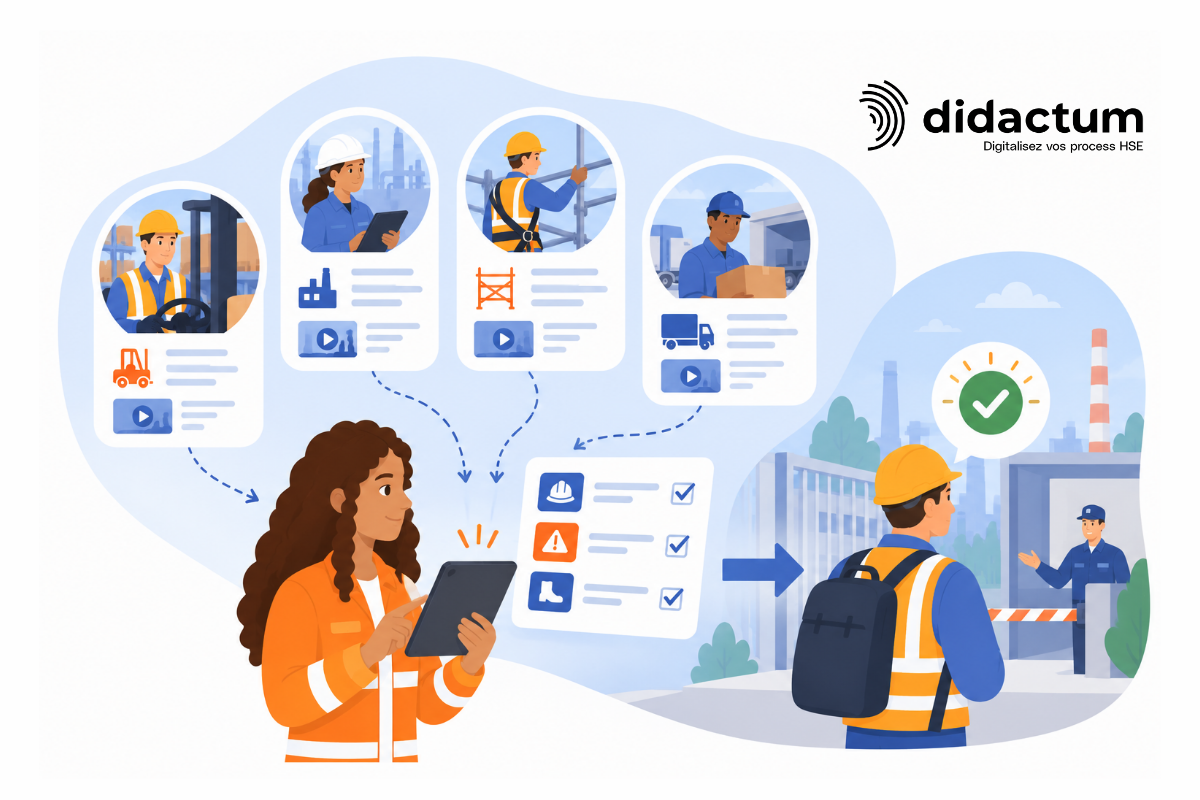
Start with the actual assignment, not just the job title
A job title provides an initial reference point for determining Safety Induction requirements. A production operator, forklift operator, and scaffolder perform different tasks and face different risks.
However, a job title alone is not always enough. Two temporary workers with the same job title may work in different environments, use different equipment, or perform tasks involving different levels of risk.
It is therefore essential to clarify the actual working conditions before defining the Safety Induction content.
Several factors can be considered:
- Job role and assigned tasks: What activities will the temporary worker perform?
- Work environment: Will they work in a production area, warehouse, traffic zone, or industrial construction site?
- Associated risks: Will they be exposed to material handling, moving equipment, work at height, simultaneous operations, or specific equipment?
- Working conditions: What specific instructions must they understand before starting work?
This initial assessment makes it possible to move from a one-size-fits-all Safety Induction to an approach built around actual work situations.
Distinguish common information from task-specific instructions
Not all safety information needs to be individualized. Some rules apply to all temporary workers, regardless of their job role. Others need to be tailored to the activities performed and the associated risks.
The goal is to strike the right balance between a common foundation and additional, targeted content.
The common foundation covers the essential information that all relevant temporary workers need to receive: general prevention principles, expected behaviors, how to report an unsafe situation, and general instructions applicable to their work environment.
Task-specific content builds on this foundation according to the job role and assignment. It may cover activity-related risks, precautions for certain operations, or rules governing the use of specific equipment.
This approach avoids two pitfalls: providing content that is too general to be useful in the field, or multiplying learning paths without a genuine need.
It is also important to distinguish between information provided in advance and instructions specific to the worksite. Safety Induction prepared before an assignment does not replace the Safety Induction conducted by the host company, which must account for the risks and rules specific to its environment.
Define simple criteria for assigning each temporary worker to the right learning path
Once the requirements have been identified, the next step is to determine how each temporary worker should be directed to the content that matches their situation.
The selection criteria must be precise enough to distinguish between different needs, but also simple enough for the people coordinating assignments on a day-to-day basis to use.
For example, a mapping matrix can link job roles or assignment types to the corresponding Safety Induction learning paths. This helps formalize decisions and limit case-by-case choices made without shared guidelines.
To build this matrix, it is useful to:
- identify the main job roles and assignment types encountered;
- identify the associated risks and safety instructions;
- determine which information should be shared and which additional content is needed;
- define the criteria for selecting the appropriate learning path;
- establish what to do when an assignment does not match any identified scenario.
This last situation deserves particular attention. When an assignment is new or the available information is insufficient, it is better to arrange an additional review than to automatically assign a learning path that does not reflect the actual work.
To explore this topic further, watch the replay of our webinar on digitalizing Safety Induction for temporary workers, featuring EOL Intérim’s experience. The webinar provides further insight into the challenges encountered in the field.
Plan for updates when assignments change
A Safety Induction learning path should not be considered a permanent decision. An assignment may evolve, a temporary worker may change roles or sites, and new instructions may become necessary.
It is therefore important to define the situations that should trigger a review of the initial learning path.
For example, a change in job role, the addition of a task involving different risks, or a significant change in working conditions may require additional information or an update to the Safety Induction.
Conversely, it is not always necessary to repeat the entire learning path. When the information already provided remains relevant, only the missing elements may need to be covered, depending on the requirements applicable to the assignment.
For this approach to work, the update criteria must be clear to the teams involved. They need to know which changes to report and whom to contact to determine whether the learning path remains appropriate.
Effective Safety Induction starts with a clear understanding of requirements
Tailoring Safety Induction for temporary workers does not mean creating a different learning path for every individual. Above all, it means understanding the assigned tasks, identifying the associated risks, and determining what information must be provided before work begins.
By distinguishing a common foundation from task-specific content, then defining criteria for assigning and updating learning paths, companies can build a Safety Induction process that better reflects real-world working conditions.
To support this approach, the didactum SaaS platform enables organizations to create and manage Safety Induction learning paths tailored to different profiles, job roles, and assignments. Content can be organized according to identified needs, delivered remotely, and updated as instructions or working conditions change. This approach helps teams structure Safety Induction in advance and establish a common framework for managing the process.
This first step lays the foundation for a broader approach: building tailored learning paths, assessing understanding of safety instructions, and organizing ongoing follow-up.
Prêt(e) à vous lancer dans la digitalisation de votre Accueil Sécurité ?
At didactum, for 30 years, we have been supporting EHS teams through this transformation by offering a SaaS platform designed for the realities of the industrial field. If you would like to discover how to simplify the management of your prevention plans while strengthening your compliance, contact our team to discuss your needs.
We put this expertise to work to guide you through your Safety Induction digitalization project
Our experts are of course available to support you every step of the way.
Contact us today for a personalized consultation and discover how our solutions can precisely meet your needs.
Contact us today for a personalized consultation and discover how our solutions can precisely meet your needs.
FAQ
Digitalizing safety induction helps save time, streamline site access flows, and track the validation of safety instructions. Didactum enables industrial sites to replace paper-based inductions with digital workflows tailored to real-world operations.
Content can vary depending on the user profile, language, site, specific risks, or type of work. Didactum enables you to create tailored workflows while maintaining a consistent safety framework.
Traceability relies on tracking logins, completed modules, quiz results, and validation of knowledge. Didactum enables EHS teams to quickly access the records required for monitoring and audits.
The main benefits include reduced manual tasks, better management of site access flows, content that is easier to update, and more reliable tracking of validations. didactum simplifies the management of safety induction at industrial sites.
 Contact us