
How to turn Safety Induction into a meaningful prevention experience before arrival on site
Safety Induction is often seen as the final step before entering an industrial site: a few safety instructions to review, some rules to acknowledge, and then access can be granted.
But what happens if we reverse this logic? What if Safety Induction also became a person’s first introduction to the site, its environment, and its safety culture, even before they pass through the gate?
This approach makes particular sense when the goal is to genuinely prepare people before they arrive, rather than simply deliver instructions at the last minute. It means thinking of Safety Induction as an experience that begins in advance while remaining closely connected to the realities of entering the site.
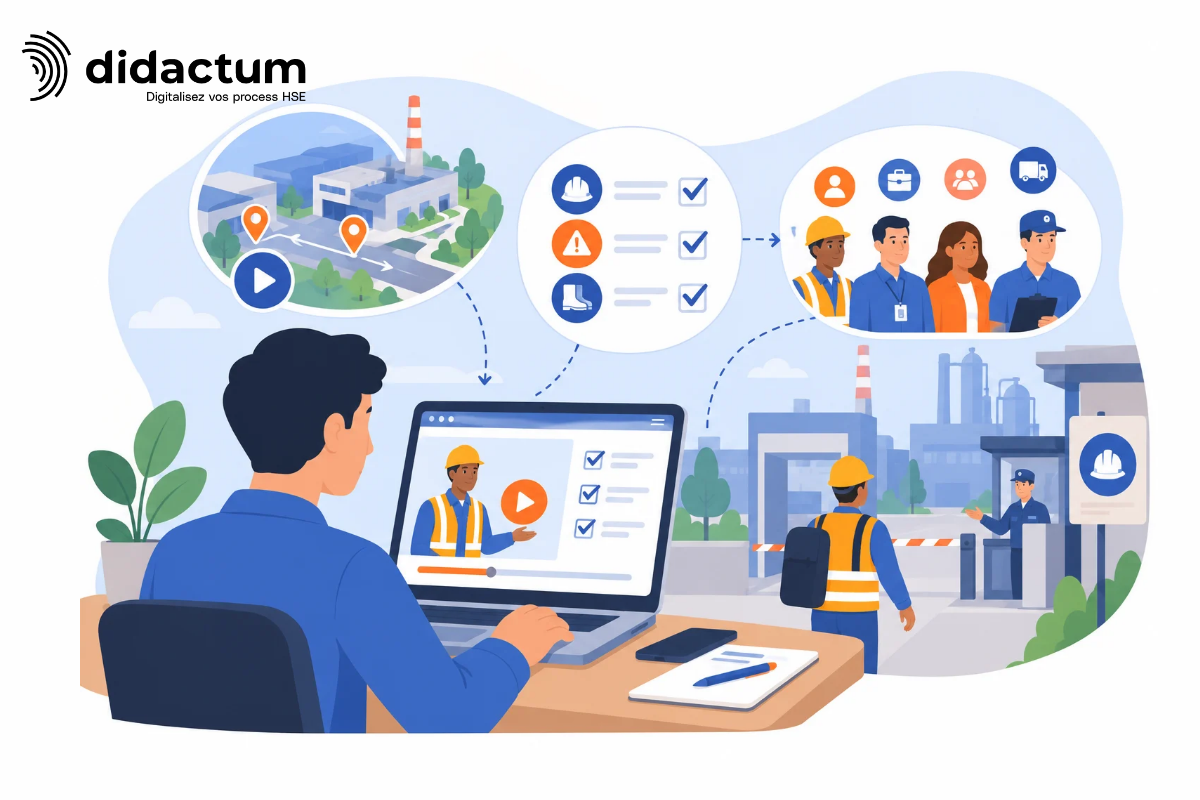
Safety Induction can begin before arrival on site
When someone’s arrival is scheduled, there is not necessarily any need to wait until the day itself to start raising awareness.
An employee visiting a new site can learn about the environment before their first day there. A contractor can be informed of the essential rules before starting work. A visitor can arrive with an initial understanding of what to expect.
The benefit is not simply completing Safety Induction earlier. More importantly, it gives people the opportunity to gradually discover the environment in which they will be working or visiting.
They can therefore arrive on site already knowing what to expect, rather than having to discover the location, the rules, and the expected behaviors all at once.
Safety Induction then becomes an initial introduction to the site, even before the person is physically present.
Show people what to expect so they can picture themselves there
Safety instructions are easier to understand when they can be connected to a real-life situation.
This is particularly true when someone is unfamiliar with the site. Where will I be walking? What do the areas I will visit look like? How does a delivery work? What behaviors are expected in this environment?
Visual formats can help answer these questions by showing people the site and the situations they may encounter. A video filmed in the actual environment, for example, can provide a concrete introduction to the location and help people picture themselves there before arriving. This is an important lesson from the experience that informs this article: discovering the environment in advance can help make a person’s first visit to the site feel more familiar.
This does not mean that video should be considered a universal solution. The goal is to choose a format that makes the information relevant and easy for the intended audience to understand.
Preparing people also means helping them picture the situation they are about to enter.
The experience cannot be the same for everyone
This is another essential consideration when looking to improve Safety Induction.
Permanent employees, visitors, contractor technicians, and drivers do not have the same needs. They do not spend time on site under the same conditions, nor are they exposed to the same risks.
Having everyone follow exactly the same learning path can therefore mean providing too much information to some people while failing to meet the needs of others.
The challenge is to maintain a common foundation while adapting the content to each person’s situation.
In the experience examined here, this approach translated into learning paths of different lengths and formats: more comprehensive content for groups with greater exposure to risk, a shorter format for visitors, and a very short, highly visual video for drivers, particularly to account for their specific constraints.
This tailored approach keeps the process practical: the goal is not to provide more information, but to give each person the information they genuinely need to enter the site safely and appropriately prepared.
The first interaction with the site matters too
This prevention experience also has another effect, one that is less directly related to safety: it shapes a person’s first impression of the site.
When an employee discovers their future work environment before their first day, a visitor receives clear, visual content before arriving, or a contractor learns how the site operates in advance, Safety Induction also becomes an initial interaction with the organization.
The quality and clarity of the content, as well as its relevance to the audience, can help convey a professional image of the site. The experience highlighted here emphasizes the value of sending Safety Induction in advance in a short, polished visual format that can reflect positively on both the company and the people receiving it.
However, this benefit should not become the primary objective. Safety Induction is not intended to serve as a marketing showcase. A positive first impression is instead the result of a well-designed prevention experience: clear, consistent, and tailored to the person receiving it.
Design the experience all the way through site entry
One essential condition remains: this advance preparation must work in practice.
Not everyone will necessarily complete Safety Induction before arriving. Work may be scheduled at short notice, a visitor may be added at the last minute, or a driver may arrive without having completed the planned learning path.
Advance preparation must therefore not create a new bottleneck.
The process should make it easy to check whether Safety Induction has been completed and, if not, provide an alternative directly on site. In the experience examined here, for example, drivers can complete their induction at the security desk if they have not done so in advance.
This continuity connects the experience prepared beforehand with the operational realities of entering the site.
Make Safety Induction a meaningful first interaction
Safety Induction can become a person’s first introduction to the site’s environment, rules, and safety culture while remaining connected to the operational realities of site entry.
When it helps people discover the location, picture themselves in the environment, receive information suited to their situation, and arrive prepared, it goes beyond simply delivering safety instructions.
People no longer have to wait until they reach the gate to start discovering the site.
Safety Induction begins as soon as people start picturing the environment they are about to enter.
This approach is therefore not simply about digitalizing existing content. Above all, it encourages organizations to consider what kind of first experience of the site and its safety rules they want to provide to everyone who enters.
This is what makes it possible to turn Safety Induction into more than just a step in the site entry process: a genuine first step in prevention.
Prêt(e) à vous lancer dans la digitalisation de votre Accueil Sécurité ?
At didactum, for 30 years, we have been supporting EHS teams through this transformation by offering a SaaS platform designed for the realities of the industrial field. If you would like to discover how to simplify the management of your prevention plans while strengthening your compliance, contact our team to discuss your needs.
We put this expertise to work to guide you through your Safety Induction digitalization project
Our experts are of course available to support you every step of the way.
Contact us today for a personalized consultation and discover how our solutions can precisely meet your needs.
Contact us today for a personalized consultation and discover how our solutions can precisely meet your needs.
FAQ
Digitalizing safety induction helps save time, streamline site access flows, and track the validation of safety instructions. Didactum enables industrial sites to replace paper-based inductions with digital workflows tailored to real-world operations.
Content can vary depending on the user profile, language, site, specific risks, or type of work. Didactum enables you to create tailored workflows while maintaining a consistent safety framework.
Traceability relies on tracking logins, completed modules, quiz results, and validation of knowledge. Didactum enables EHS teams to quickly access the records required for monitoring and audits.
The main benefits include reduced manual tasks, better management of site access flows, content that is easier to update, and more reliable tracking of validations. didactum simplifies the management of safety induction at industrial sites.
 Contact us