
EHS training: why knowledge validation makes all the difference
In many organizations, EHS training and Safety Induction programs still follow a relatively straightforward principle: provide the right information to the right people at the right time.
Whether delivered through classroom sessions, videos, digital learning modules, or field-based instruction, the objective remains the same: communicate essential safety requirements and ensure that employees, contractors, temporary workers, and visitors receive the information they need before starting work.
Yet for many EHS managers, one question remains difficult to answer:
Did participants actually understand the information they received?
Simply attending a training session or watching a video does not necessarily mean someone will be able to apply those safety requirements correctly when they return to the workplace. This is precisely why knowledge validation has become an increasingly important part of modern EHS training.
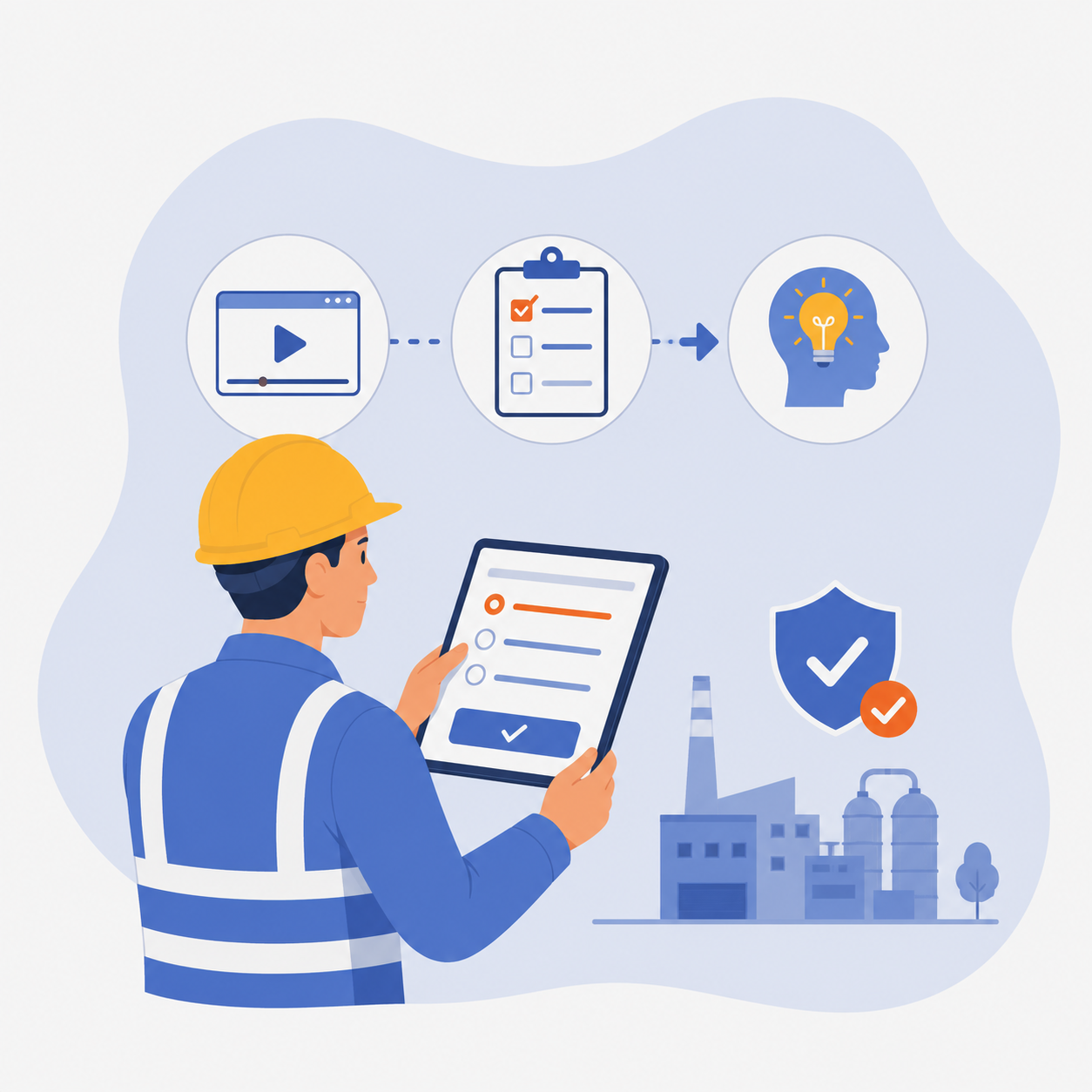
Delivering information does not guarantee understanding
Communicating safety requirements is a fundamental part of every EHS program. However, communication alone has an obvious limitation: it does not always measure what people have actually understood or retained.
Consider a simple example.
At the end of a Safety Induction session, every participant has received the same information. Yet some will clearly understand the site’s critical safety requirements, while others will remember only part of what was presented. The more comprehensive the content, the more pronounced this difference becomes. Site-specific hazards, traffic rules, personal protective equipment (PPE), emergency procedures, and safe work practices all require participants to absorb a significant amount of information.
Without a way to verify understanding, it becomes difficult to know what participants have actually learned.
The challenge goes beyond compliance
For many years, the primary objective was simply to demonstrate that training had been completed.
A signed attendance record or completion certificate was often considered sufficient evidence that an employee or contractor had participated in a Safety Induction or awareness session.
Today, expectations have evolved.
Increasingly, EHS managers want to verify that workers genuinely understand the safety requirements they have been given, particularly in environments with higher risks or highly diverse workforces.
Several factors have contributed to this shift:
- a growing reliance on contractors;
- an increasing use of temporary workers;
- multilingual workforces;
- higher expectations during audits;
- a stronger focus on improving the effectiveness of risk prevention programs.
In this environment, simply proving that someone attended a training session is no longer enough for many organizations.
Knowledge validation turns learners into active participants
This is where knowledge validation makes a real difference.
When learners are asked to answer a few questions or work through a realistic scenario, they are no longer passive recipients of information. They must actively recall and apply what they have just learned. This fundamentally changes the learning experience. Instead of simply completing a mandatory training requirement, participants must demonstrate that they understand the critical safety information presented to them.
This active involvement typically leads to greater engagement, stronger knowledge retention, and a better understanding of essential safety requirements.
Identifying knowledge gaps before they become safety risks
Knowledge validation benefits more than just learners. It also provides EHS teams with valuable insights into the effectiveness of their training programs. When a large number of participants struggle with the same question, it often points to a broader issue.
Is the content clear enough?
Is the message appropriate for the intended audience?
Would certain topics benefit from additional explanation or practical examples?
These insights help organizations continuously improve their training content. Instead of remaining a static program that changes very little over time, EHS training can evolve based on real feedback and learning outcomes.
A practical approach for increasingly diverse workforces
Knowledge validation becomes especially valuable when organizations train large and diverse audiences. New employees, temporary workers, contractors, visitors, and drivers all have different responsibilities, different levels of experience, and different learning needs. Many organizations also operate in multilingual environments or onboard large numbers of workers every year.
In these situations, it is virtually impossible for EHS teams to individually verify every participant’s understanding. Knowledge assessments provide an efficient first level of verification while remaining compatible with day-to-day operational constraints.
Understanding is just as important as delivering information
The effectiveness of an EHS training program is not measured by how much information it delivers. It is measured by how well people can apply what they have learned when they are back in the workplace. Knowledge validation helps bridge the gap between providing information and ensuring that information can be put into practice. It shifts the focus from simply delivering safety requirements to confirming that workers understand them and are prepared to apply them in real-world situations.
When safety procedures have a direct impact on people’s health and well-being, that distinction becomes especially important.
How didactum uses knowledge validation
At didactum, quizzes and knowledge assessments are designed to do much more than measure performance.
They are integrated into a broader learning strategy that helps capture learners’ attention, increase engagement, and provide EHS teams with valuable insights into the topics that may require additional explanation or reinforcement.
This approach not only provides complete traceability of completed learning paths, but also gives organizations greater visibility into how well participants understand critical safety requirements—particularly in environments where large numbers of users, diverse audiences, and operational constraints make individual follow-up difficult.
Ready to digitalize your prevention plans?
At didactum, for 30 years, we have been supporting EHS teams through this transformation by offering a SaaS platform designed for the realities of the industrial field. If you would like to discover how to simplify the management of your prevention plans while strengthening your compliance, contact our team to discuss your needs.
We put this expertise to work to guide you through your Safety Induction digitalization project
Our experts are of course available to support you every step of the way.
Contact us today for a personalized consultation and discover how our solutions can precisely meet your needs.
FAQ
Digitalizing safety induction helps save time, streamline site access flows, and track the validation of safety instructions. Didactum enables industrial sites to replace paper-based inductions with digital workflows tailored to real-world operations.
Content can vary depending on the user profile, language, site, specific risks, or type of work. Didactum enables you to create tailored workflows while maintaining a consistent safety framework.
Traceability relies on tracking logins, completed modules, quiz results, and validation of knowledge. Didactum enables EHS teams to quickly access the records required for monitoring and audits.
The main benefits include reduced manual tasks, better management of site access flows, content that is easier to update, and more reliable tracking of validations. didactum simplifies the management of safety induction at industrial sites.
 Contact us